• Skip to primary navigation
  • Skip to main content
CURIO SG

CURIO SG

Holistic Education

  • Home
  • Programmes
    • Secondary School Programmes
      • English Language ‘O’ Level Programme
      • English Literature ‘O’ Level Programme
    • Junior College Programmes
      • English Literature ‘A’ Level Programme
      • GCE ‘A’ Levels: General Paper
    • IP
      • IP Programme: English Language
      • IP Programme: English Literature
    • Crash Courses
      • O Levels English Language
  • Free Resources
  • About
  • Journal
  • Shop Assessment Books & Exam Papers
  • Show Search
Hide Search
You are here: Home / Archives for curiosg

curiosg

Haroun and the Sea of Stories: Author’s Background

curiosg · March 8, 2024 · Leave a Comment

"Through 'Haroun and the Sea of Stories,' Salman Rushdie mirrors his path from Bombay to literary prominence, embracing adversity with the captivating allure of storytelling."
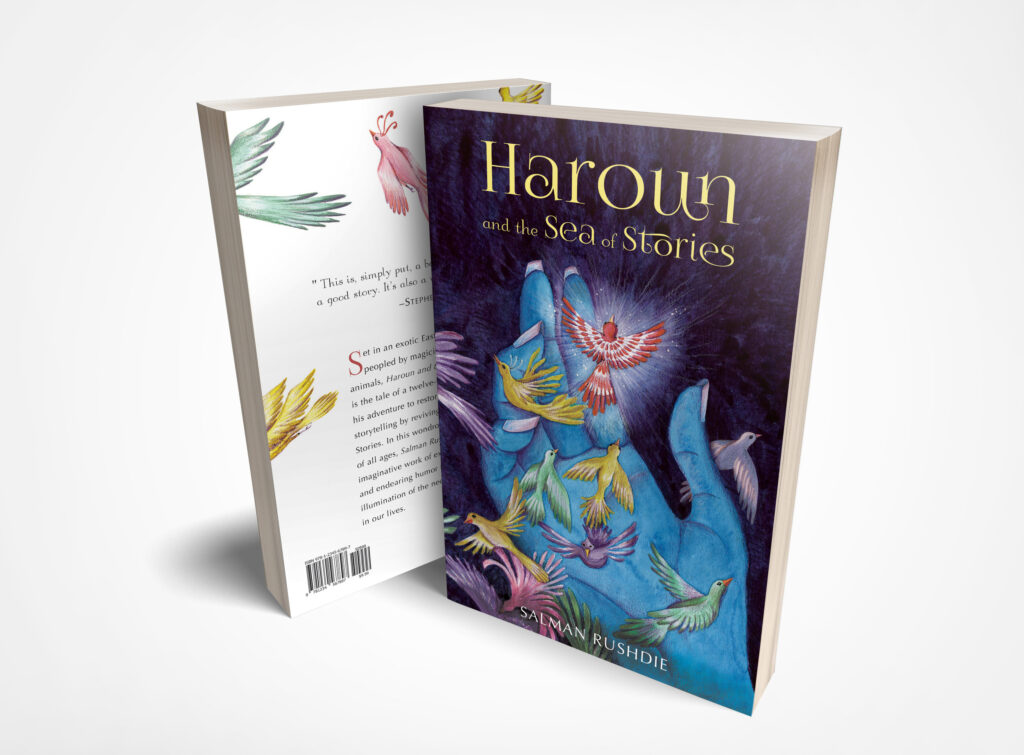

Salman Rushdie, a British-Indian author born on June 19, 1947, in Bombay (now Mumbai), India, has established himself as a prominent figure in contemporary literature. Known for his mastery in blending magical realism with political and historical narratives, Rushdie gained international acclaim with his critically acclaimed and controversial novel, “The Satanic Verses.”

Rushdie’s early life was marked by a multicultural upbringing, reflecting the diversity of his heritage. He pursued higher education in England, attending King’s College, University of Cambridge, where he studied history. His literary career began with the publication of his first novel, “Grimus,” in 1975, but it was the release of “Midnight’s Children” in 1981 that catapulted him to literary stardom. The novel, exploring the history of post-colonial India through the lives of its protagonists, won the Booker Prize and the Booker of Bookers, further solidifying Rushdie’s reputation as a literary force.

However, Rushdie’s life took a dramatic turn with the publication of “The Satanic Verses” in 1988. The novel, which explored themes of religion and identity, ignited widespread controversy and led to a fatwa (religious decree) issued against Rushdie by Iran’s Ayatollah Ruhollah Khomeini. The fatwa, calling for Rushdie’s assassination, forced him into hiding for several years, during which he continued to write and advocate for freedom of expression.

Amidst the challenges and threats he faced, Salman Rushdie authored “Haroun and the Sea of Stories,” a departure from his previous works in terms of genre and tone. Published in 1990, the novel is a fantastical tale that intertwines elements of myth, fable, and allegory. “Haroun and the Sea of Stories” is a story within a story, unfolding in a magical land where storytelling is integral to maintaining harmony and balance. The protagonist, Haroun, embarks on a quest to restore the Sea of Stories after it is polluted by dark forces.

The reasons behind Rushdie’s creation of “Haroun and the Sea of Stories” are multi-faceted. The novel, written during a tumultuous period in the author’s life, served as a creative sanctuary and a means of expressing resilience in the face of adversity. It allowed Rushdie to delve into the enchanting realm of storytelling, offering a cathartic escape from the harsh realities he confronted. Furthermore, the narrative in “Haroun and the Sea of Stories” can be interpreted as a celebration of the power of storytelling, emphasising its role in preserving cultural identity, combating censorship, and fostering imagination.

In crafting “Haroun and the Sea of Stories,” Salman Rushdie demonstrated not only his versatility as a storyteller but also his ability to navigate complex themes with grace and humour. The novel stands as a testament to his unwavering commitment to the transformative and redemptive power of literature, even in the face of profound personal and political challenges.

What Parents Need to Know About Secondary School Curriculum

curiosg · January 22, 2024 · 10 Comments

"In 2024, as Secondary 1 students undergo transformative changes with Full Subject-Based Banding, parents play a crucial role in understanding and guiding their child through the new educational landscape."

Secondary 1 students will see a major transformation to their academic landscape starting in 2024. Full Subject-Based Banding (Full SBB) is replacing the traditional Normal (Technical), Normal (Academic), and Express streams. Students will be classified into Posting Groups 1, 2, or 3 based on their academic progress. The improved approach empowers students by offering them additional subject selection options. This article aims to provide valuable insights into the secondary school curriculum for parents who may not yet understand the new education system for Secondary 1 in Singapore.

1. Subjects With a Higher Level of Difficulty

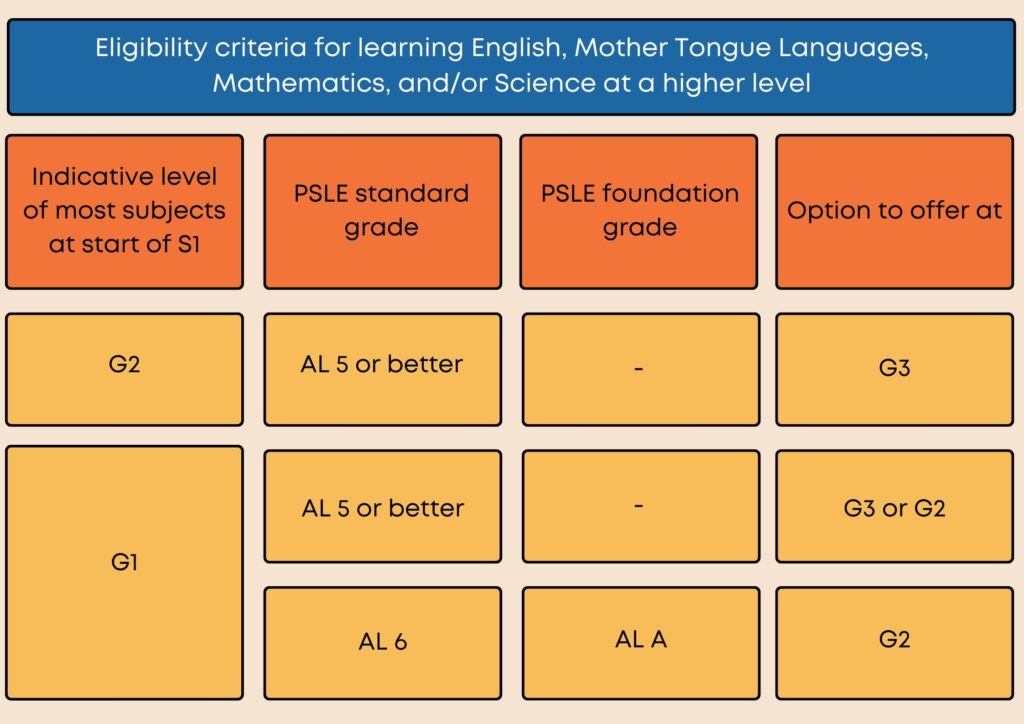
Students in Secondary 1 (Sec 1) begin with subjects based on their overall PSLE score or if they perform well in individual PSLE subjects, they can opt to study them at a more demanding level. Students may also be offered the option to pursue specific subjects at a less difficult level in Sec 1. 

At the beginning of Sec 1, eligible students can choose to take English Language, Mother Tongue Languages, Mathematics, and Science at a more challenging level, determined by their PSLE Achievement Level (AL) in each subject. As students proceed beyond the first stage of Sec 1, they may continue to take these subjects at a more demanding level based on their achievement in secondary school. Starting from Secondary 2 (Sec 2), students also have the opportunity to take Humanities subjects (Geography, History, and Literature in English) at a more challenging level. The decision to undertake Humanities at a higher difficulty level will depend on students’ aptitude and interest in these subjects, as determined in Sec 1.

2. Subjects with a Lower Level of Difficulty

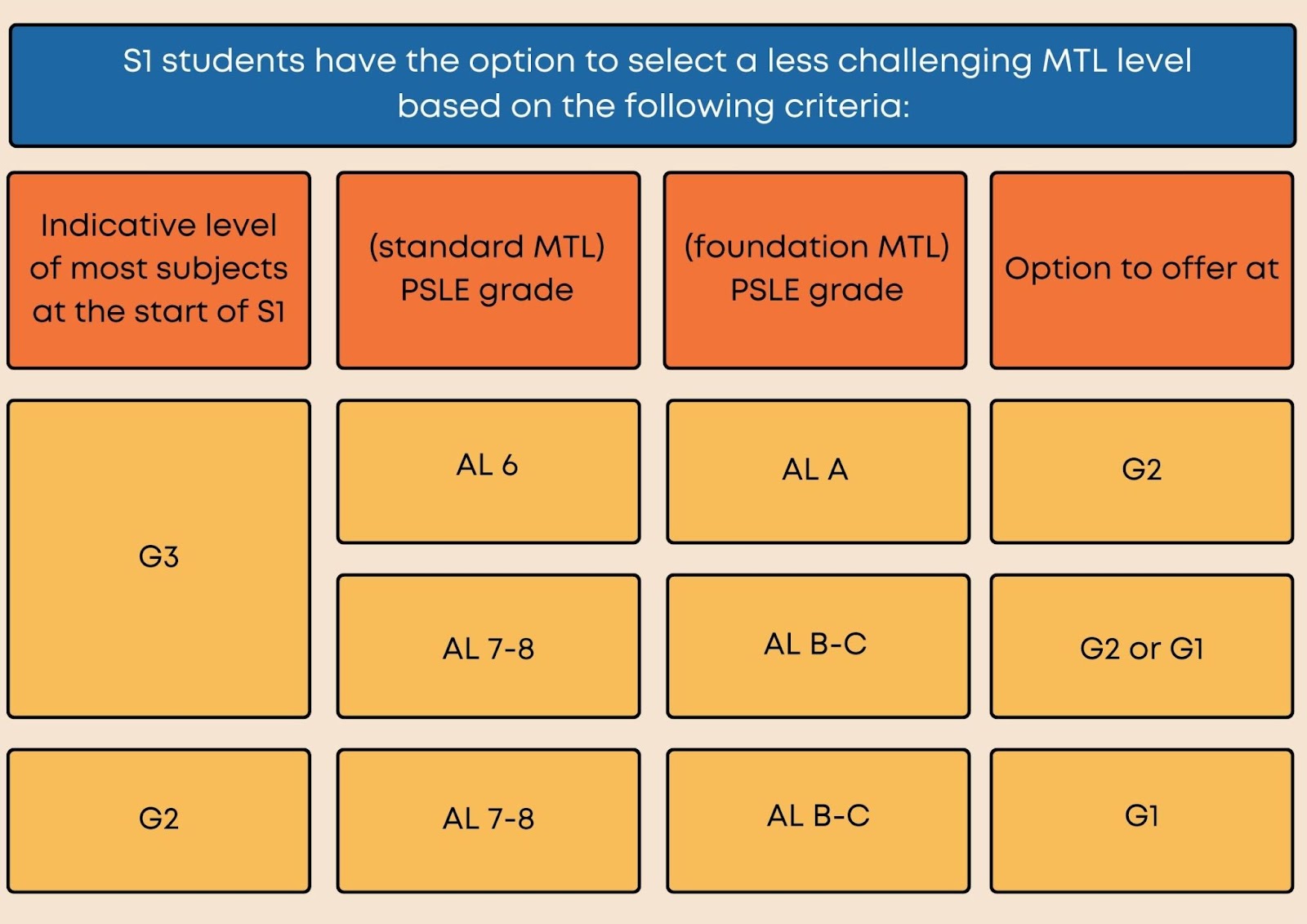
Students who previously opted for Foundation level in English, Mathematics, and/or Science during their PSLE but are otherwise eligible for G3 in most subjects when transitioning to secondary school have the option to take these subjects at a less challenging level (i.e., G2) at the start of Secondary 1 (Sec 1). 

For students who are find their Mother Tongue Languages (MTL), to be challenging, the option of G1 or G2 MTL is provided. During the first phase of Sec 1, students can choose a less rigorous MTL level depending on specific criteria.

As students proceed beyond the first phases of Sec 1, they have the opportunity to offer subjects at a less demanding level, taking into account their performance and the schools’ complete assessment to balance their academic workload. Students choosing subjects at a less demanding level can subsequently opt for a more challenging level as they enhance their competence and confidence in those subjects. This additional flexibility enables students to adapt their learning experience to their particular abilities and passions.

3. Subjects at Lower Secondary

a. Common Curriculum Subjects

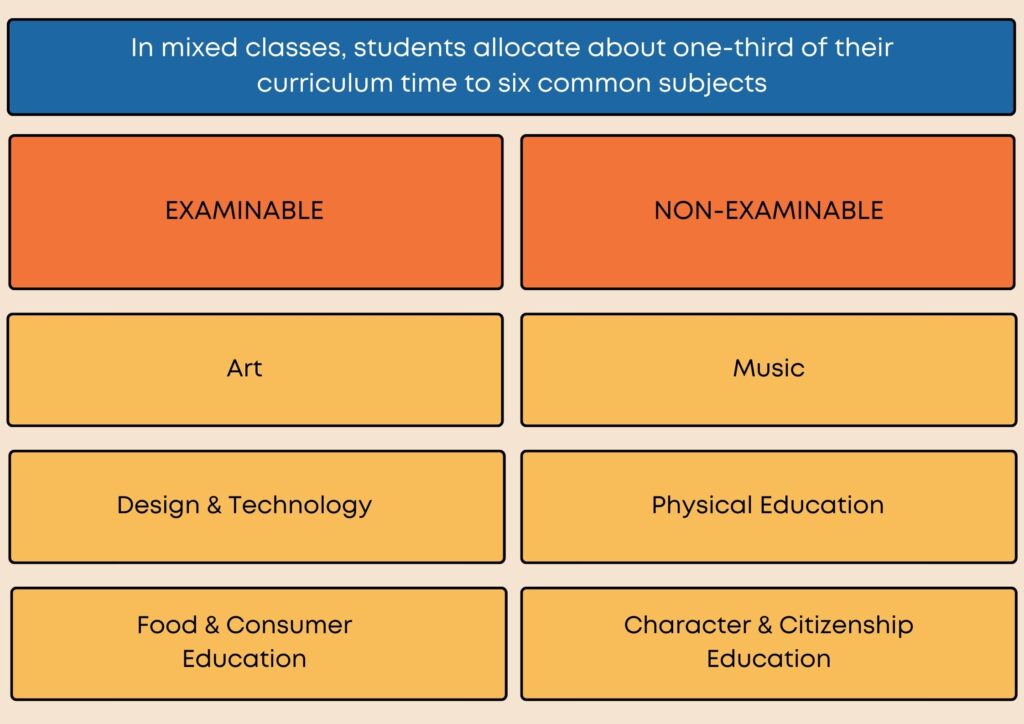
Students in mixed-form classes are going to devote approximately one-third of their curriculum time to a set of six common curriculum subjects. These subjects aim to improve students’ collaborative learning experiences by allowing them to connect and learn with classmates who have a wide range of abilities and interests.

Teachers will employ a variety of teaching techniques to properly cater to the student’s particular needs while acknowledging the different learning demands and paces within the same form of class.

b. Subjects Offered at G1, G2 and G3

English Language, Mother Tongue Languages, Mathematics, Science, and Humanities subjects will be available at G1, G2, and G3 levels. Students will be organized into different classes based on their subject level for each of these subjects.

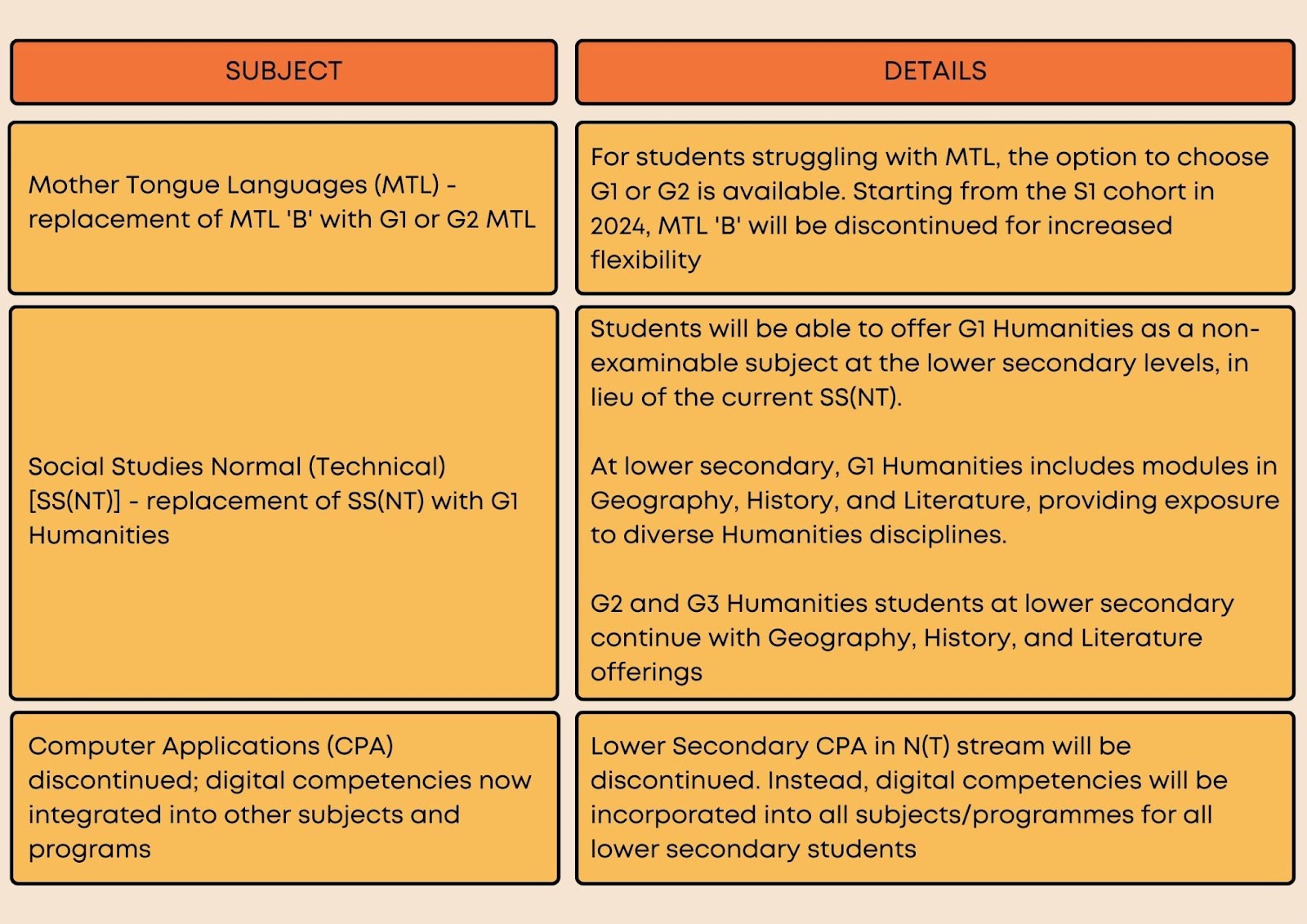
Starting from the 2024 Secondary 1 (S1) cohort, additional curriculum policy changes will also be introduced to further enhance the learning experience for students:

4. Subjects at Upper Secondary

Photo by Pixabay on Pexels

a. Compulsory Subjects

The subjects that are mandatory in upper secondary include:

  • English Language
  • Mother Tongue Languages (MTL)
    • Eligible students may offer HMTL instead of MTL
  • Humanities
    • G1 Humanities will comprise Social Studies and one Humanities Exposure Module (HEM) in Geography, History or Literature in English. 
    • G2/3 Humanities will comprise Social Studies and choice of one elective in Geography, History or Literature in English or Literature in Mother Tongue Languages (offered at G3 only).
  • Mathematics
  • Science
    • Students offering mainly G1 subjects at upper secondary must offer at least one of the following subjects – Computing or Science.

b. Elective Subjects

Students get to choose subjects that interest them, such as Additional Mathematics, Art, and Design & Technology. Schools will assist them in determining the appropriate level for each subject based on their interests and strengths, taking into account their academic performance and areas for improvement.

c. Other Programmes – Applied Learning Modules (ApLM)

ApLMs are optional courses in practical subjects offered by Polytechnics, ITE, and private organisations. From 2023 onwards, students from Secondary 2 to Secondary 5 can join these modules, and each student can participate in up to 3 ApLM throughout their secondary education.

Wide Sargasso Sea: ‘The Madwoman in the Attic’

curiosg · July 20, 2023 · 2 Comments

“There are always two deaths, the real one and the one people know about.”

― Jean Rhys, Wide Sargasso Sea

The book “Wide Sargasso Sea” by Jean Rhys was published in 1966 and is seen as a prequel and response to Charlotte Brontë’s famous novel “Jane Eyre.” It explores the story of Bertha Mason, the “madwoman in the attic” from “Jane Eyre,” and gives her a voice and a more extensive backstory.

The novel’s events take place in Jamaica in the early nineteenth century. It centers on Antoinette Cosway, a wealthy Creole woman who eventually marries Mr. Rochester in “Jane Eyre.” Rhys delves into Antoinette’s upbringing in Jamaica, her planned marriage to Mr. Rochester, and the events that led to her eventual insanity.

You can use the worksheets below to study on your own. if you want helpful feedback with detailed comments, you can try out the English Literature Programme that’s only on Curio.sg!

The-Emancipation-Act-of-1833 Download
Essay-Questions-Wide-Sargasso-Sea-4 Download
Wide-Sargasso-Sea-Quotes-Themes-Part-1 Download
Jean-Rhys-Wide-Sargasso-Sea_-Background-1 Download
Significance-of-the-title-Wide-Sargasso-Sea-1Download
Themes-in-Wide-Sargasso-Sea-by-Jean-RhysDownload

Animal Farm: Satire and Rebellion in a Farmyard

curiosg · July 19, 2023 · 1 Comment

“All animals are equal, but some animals are more equal than others.”

― George Orwell, Animal Farm

Animal Farm is a satirical novel which was written by George Orwell in 1945. It tells the story of Manor Farm, where the animals are subjected to the harsh authority of Mr. Jones, a farmer. The animals, led by the pigs Napoleon and Snowball, dream of a fair and equal society, so they rebel against the humans and take over the farm.

What Is the Story of Animal Farm Based On?

This novel is a satire, which means it criticises something using comedy and irony. In this context, it is based on events prior to the 1917 Russian Revolution and the early years of the Soviet Union. Each animal in the book is a representation of a real person, such as Joseph Stalin, Karl Marx, or Leon Trotsky. The author intended to demonstrate how power can corrupt and how revolutions may occasionally go awry.

Why is Animal Farm so Famous?

The book gained popularity due to its trenchant criticism of political systems, specifically the Soviet Union under Stalin. George Orwell’s brilliant use of analogy and satire allowed him to convey complex ideas in an engaging and approachable way. By employing animals as protagonists, he addressed the dangers of authoritarianism, corruption, and power manipulation. The novel’s enduring relevance and imaginative storytelling continue to captivate readers, solidifying its reputation as a recognised and significant literary masterpiece.

Is Animal Farm a Banned Book, and What Are the Benefits of Reading It?

Animal Farm has been subjected to restrictions and bans in some regions. The book has been called controversial due to its critique of political ideologies and portrayal of power dynamics. However, it is important to note that the extent of censorship varies across different time periods and regions.

Reading Animal Farm helps develop critical thinking, historical awareness and an understanding of the complexities of power and governance. It encourages readers to remain mindful of oppression and serves as a reminder of the need to uphold democratic values and protect individual freedoms.

Click on the resources below for notes on Animal Farm. If you need more help understanding the text, check out the English Literature Programme exclusively on Curio.sg!

Animal-Farm-Background-Introduction-CurioDownload

Animal-Farm-Character-List-Curio-1Download

The-Russian-Revolution-of-1917-and-Stalins-Rule-Curio-1Download

How to Score in Literature – Download Free Notes ‘Gossamer’

curiosg · June 8, 2023 · 2 Comments

“Everything that you're a part of. Your own story fills you.”

― Lois Lowry, Gossamer

If you enjoy learning Literature, but are unsure of how to score, you have come to the right place. Furthermore, beyond annotating and understanding your text, the best way to score better for your tests is to practice your analysis and writing. Download the free quizzes and worksheets on this page if you are studying ‘Gossamer’ by Lois Lowry.

What Is ‘Gossamer’ About?

Gossamer is a captivating novel about the power of dreams, written by Lois Lowry and published in 2006. It is a unique novel that blends fantasy and realism, perfect for young adult readers. The story delves into the intriguing origins of dreams and centres around the adventures of Littlest One, a magical and fairy-like creature. Littlest One has a special ability to collect memories from everyday objects and use them to weave and bestow mesmerising dreams. While Littlest One is the main character, there are other fascinating characters in the book. Her mentor, Thin Elderly, a kind old woman, John, a troubled and angry young boy, and a loyal dog named Toby.

Feel free to download the chapter summary questions and give them a try. Further, if you’d like to receive valuable feedback with detailed comments on how to improve, you can explore the ‘Independent’ Marking & Feedback‘ exclusively available on Curio.sg!

How Does ‘Independent’ Marking & Feedback‘ Work?

When students sign up for this option, they will receive personalised notes and worksheets once a week. The student’s task is to complete these worksheets and email them back to their assigned tutor. Using google docs, the tutor will mark and provide detailed feedback to the student. They will also assign a mark based on rubrics (these can be rubrics used by the student’s school, or rubrics from the ‘O’ level programme).

Students who are motivated and driven will benefit from these feedback cycles, as they will always have personalised attention paid to their progress.

Studying ‘Gossamer’ and need some extra help? Check out the quizzes below and see if you can find all the answers from your text!

Gossamer-1-8-CurioDownload

Gossamer-13-15-Curio-1Download

Gossamer-16-18-CurioDownload

Gossamer-19-21-CurioDownload

GCE ‘O’ Level English Language Exam Papers (1128)

curiosg · June 8, 2023 · 19 Comments

"Download past GCE 'O' Level English papers, practice and get feedback with Curio.sg's marking coach!"

Past year GCE ‘O’ Level English papers can be downloaded below. Students should try out all the papers and submit them to their teachers to mark. If you need your papers to be graded and returned to you with comprehensive feedback on how to improve, try the ‘Independent’ Marking & Feedback plan on Curio.sg to get yourself a dedicated marking coach!

2015_GCE-O-LEVEL-ENGLISH-1128-Paper-1Download
2015_GCE-O-LEVEL-ENGLISH-1128-Paper-2Download
2016_GCE-O-LEVEL-ENGLISH-1128-Paper-1Download
2016_GCE-O-LEVEL-ENGLISH-1128-Paper-2Download
2017_GCE-O-LEVEL-ENGLISH-1128-Paper-1Download
2017_GCE-O-LEVEL-ENGLISH-1128-Paper-2Download
2018_GCE-O-LEVEL-ENGLISH-1128-Paper-1Download
2018_GCE-O-LEVEL-ENGLISH-1128-Paper-2Download
2019_GCE-O-LEVEL-ENGLISH-1128-Paper-1Download
2019_GCE-O-LEVEL-ENGLISH-1128-Paper-2Download
2020_GCE-O-LEVEL-ENGLISH-1128_Paper-1Download
2020_GCE-O-LEVEL-ENGLISH-1128-Paper-2Download

How Online Learning is Reshaping Education

curiosg · April 9, 2023 · Leave a Comment

"When you choose online education, you will have more freedom to balance your career, education, and personal life without the constraints of a set schedule."

Nowadays, students have a lot of options when it comes to their education. They can choose to attend a traditional school or they can study online. While there are many benefits of attending a physical school, online education has become a more popular and viable option in recent years. 

Here are some reasons why online education is becoming a better choice for students:

1. It Is More Affordable Than Traditional Education

Photo by Yan Krukau on Pexels

The cost of education has skyrocketed over the past few years. Online education, however, is more affordable and accessible to a larger group of people. It eliminates many of the traditional costs associated with education, such as commuting and textbooks. 

In addition to this, there are usually discounts available for those who choose online education. This makes it a great option for those who are looking for an education that won’t break the bank.

2. It Offers More Flexibility

Photo by Katerina Holmes on Pexels

Online education allows students to work at their own pace and pursue an education that best suits their learning styles. This is great for students who may struggle with traditional education, as they can choose a format of education that helps them learn more effectively. It also gives students more time to pursue other interests outside of school, such as sports and other hobbies.

3. It Allows for More International Opportunities

Photo by Max Fischer on Pexels

Online education allows students to explore different cultures without having to leave their homes. This is especially beneficial for students who are looking for a way to experience the world without spending extensive amounts of money on travel expenses. 

With online education, students can easily connect with others from different countries and learn about their cultures. They can even take classes taught by instructors located in other parts of the world.

4. It Offers More Content Than Traditional Education

Photo by Ketut Subiyanto on Pexels

Online education provides access to plenty of educational content that is not available in physical classrooms. This includes videos, tutorials, quizzes, exercises, and interactive learning materials like simulations or virtual reality-based lessons. This extra content is available at any moment from anywhere, which will offer you a more dynamic and tailor-made education.

5. It Eliminates Geographical Constraints

Photo by Antoni Shkraba Studio on Pexels

Traditional education often limits young people from studying in the exact physical location for extended periods. With online education, students can study anywhere and anytime with just an internet connection and a device such as a laptop or a tablet. This makes it easier for them to move around without having to worry about finding a new school or enrolling in a new program.

6. It Allows for a Customized Learning Experience

Photo by Annushka Ahuja on Pexels

We have mentioned how flexibility can help with education, but the even bigger benefit of online education is the ability to customise your learning experience. With most traditional education systems, students are required to follow a particular curriculum that may not be able to meet their specific needs. 

On the other hand, with online education, you can choose courses and resources that cater specifically to your own goals and interests. This allows you to focus on what matters most and spend more time studying topics that are relevant to your career or personal development.

7. It Promotes Independent Learning

Photo by Julia M Cameron on Pexels

Online education encourages independent learning by offering plenty of self-directed activities like researching material online or engaging in discussion forums with peers from around the world. For students who are used to having someone telling them what to do in a traditional education setting, this can be a refreshing change and a great way to develop self-discipline.

8. It Helps Students Stay Connected With the Digital World

Photo by Zen Chung on Pexels

With online education, students don’t have to worry about being left behind in the digital age. Through online education, they can learn how to use technology properly and get comfortable with new tools such as video conferencing or virtual learning environments that are used in many workplaces today. This not only keeps them up-to-date but also gives them an edge when looking for jobs after graduation.

In sum, online education is an excellent choice for students who are looking for a more modern and flexible way of pursuing their education.

NFTs and Society: Pioneering a New Era of Possibilities

curiosg · April 7, 2023 · Leave a Comment

"NFTs have already begun to be used in a variety of ways, from raising money for charity to being sold as collectibles. "

Non-fungible tokens (NFTs) are new digital assets that have begun to revolutionise how we think about and interact with ownership, identity, and the economy. NFTs are the modern way for people to express themselves and share ideas. They are unique in that they cannot be replicated, meaning each one is entirely individual and can hold immense value. NFTs have already begun to be used in a variety of ways, from raising money for charity to being sold as collectibles. 

Because NFTs are so new, their future is uncertain, but there is potential for them to become very popular as more people learn about them. This article explains what NFTs are and what implications they have for the future of society.

What Are NFTs and How Do They Work?

Photo by Choong Deng Xiang on Unsplash

NFTs are blockchain-based digital assets representing art, music, videos, or other forms of media. NFTs use cryptography to ensure that each asset is unique and can be securely tracked and transferred from one owner to another. This technology has enabled NFTs to become a medium for creating non-fungible tokens that have tangible value in the modern economy.

As NFT technology continues to gain traction, it could potentially be used to create digital identities for individuals or organizations with secure tracking mechanisms. This could help ensure that no one’s personal information is shared without consent, while still allowing them to authenticate.

The History of NFTs

Photo by Art Rachen on Unsplash

NFTs have a long and varied history, with the concept being first proposed back in 2012. Since then, there has been a lot of experimentation and development in the space, with platforms such as Ethereum gaining ground as leaders in NFT technology. 

NFTs have grown in popularity and are now being used in a variety of different fields such as gaming and finance. NFTs can also be used to verify ownership of intellectual property or digital art and music. They are also being used to tokenize physical objects such as real estate, cars, and jewelry. NFTs have the potential to revolutionize how society views ownership, identity, and the modern economy.

How NFTs Are Changing the Way We Think

Photo by Barbora Dostálová on Unsplash

NFTs are changing the way we think about ownership, identity, and economy by allowing individuals to own digital assets securely and with more confidence. NFTs can be used to tokenize physical objects, giving them tangible value in the modern economy. NFTs also have implications for society as a whole, as they could potentially revolutionize how people interact with ownership and identity on a broader scale. 

NFTs could provide new opportunities for entrepreneurs, creators, social media influencers, and other users to monetize their work without relying on third-party intermediaries. NFT technology could also open up new markets for investors looking for alternative asset classes or ways to diversify their portfolios.

NFTs may even change the way we interact with each other in modern society by allowing us to authenticate our identities securely on a blockchain-based platform. As NFT technology continues to develop, it is worth keeping an eye out for what implications these revolutionary assets will have for the future of society.

What Are the Benefits and Risks Associated with Investing in NFTs?

Photo by Arstin Chen on Unsplash

NFT investing carries both potential benefits and risks. NFTs can provide investors with access to alternative asset classes that are not typically available through traditional methods, as well as diversification in their portfolios. NFTs could also open up new markets, allowing investors to invest in works of art, music, and other digital assets.  However, NFT investments come with the same risk factors associated with any type of investment, such as market volatility and liquidity risk. 

NFT investments are also subject to the same regulatory requirements as traditional investments. Therefore, investors should always do their research before investing in NFTs. Ultimately, investors need to recognize both the potential benefits and risks associated with NFT investing before making any decisions.

How Are NFTs Impacting the Future of Society?

Photo by Adi Constantin on Unsplash

NFTs are just the beginning of what could be a revolution in digital asset ownership. In addition to being used to tokenise real world assets such as art, music, and even real estate, NFTs can also represent unique items such as virtual trading cards or collectible figurines that derive value from scarcity or exclusive access. These tokens serve as certificates of ownership for digital assets which can then be traded on popular NFT marketplaces like OpenSea and Rarible. 

NFTs may become increasingly important over time due to their ability to tokenize physical artwork, allowing it to be sold digitally without losing its original source material. This could mean that artists could receive royalties for works they create and license them out to customers. NFTs could also open up new opportunities for creators of digital art, music and even virtual environments as they would be able to license their work out securely and receive payments directly from consumers. 

NFTs have the potential to become a major part of our modern economy and culture in the years to come, allowing creators and consumers alike to benefit from unique digital assets with guaranteed ownership rights. It will be fascinating to see what the future holds for NFTs. NFT technology may still be in its early stages, but its implications are huge.

O-Level Triumph: 6 Essential Tips for Early Preparation

curiosg · April 4, 2023 · 2 Comments

"Passing the O-Levels is not just an achievement, it's a key that unlocks many doors of opportunity. It can pave the way for a successful academic career and set the foundation for a brighter future."

The O-Levels are an important milestone for students as it can open many doors of opportunity for their futures. The O-Levels can be a gateway to a successful academic career. Whether it involves juggling difficult subjects, CCAs, your social life, tuition or family affairs, it’s important to get your head in the game and make sure you’re ready to tackle these high-stakes exams. Here are 6 essential tips that will help students prepare effectively for the O-Levels!

1. Creating an O-Level Exam Timetable

Creating an O-Level exam timetable will help you keep track of what topics you need to cover and when to be fully prepared for the O-Level exams. Prioritize subjects that will need more of your attention and plan accordingly. Make sure to factor in sufficient breaks between study sessions to rest and re-energize before jumping back into studying again. 6 hours without a break will only break you. Regular pauses will help you stay focused and motivated to keep studying. Create a realistic study timetable that takes into account other commitments such as tuition and extracurricular activities. Being able to manage your time well is essential for O-Level preparation.

2. Dealing With Pre-exam Stress and Anxiety

O-Levels can be a nerve-wracking experience, and it is normal to feel some anxiety before taking them. It is important to take steps to manage your emotions so that they don’t interfere with your performance. Some options are:  

  • Talk with friends and family about how you are feeling to reduce the sense of isolation that often accompanies pre-exam stress.
  • Meditate or practice deep breathing exercises to clear your mind of stressful thoughts and feelings.
  • Start early and pace yourself. 
  • Find a relaxing hobby that does not take too much time – or become too addictive – and absorb yourself in it whenever you feel too much pressure

O-Levels are not a sprint, they are more like a marathon. Start preparing for your O-Levels months before the actual exams. This will give you enough time to thoroughly review the material and deepen your understanding of the topics.

3. Taking Care of Your Physical Health During O-Level Preparations

Photo by cottonbro studio on Pexels

O-Levels can be mentally and physically taxing, and it is important to take care of yourself while you prepare. Getting enough sleep each night is essential for staying sharp during study or tuition sessions and consolidating newly acquired knowledge and improving memory retention. 

Make sure to eat well-balanced meals throughout the day to fuel your body with all the necessary nutrients. Eating a balanced diet full of fresh fruits, vegetables, and whole grains will provide you with the energy you need to power through your studying sessions. Additionally, don’t forget to stay hydrated by drinking enough water throughout the day, and remember that exercising regularly will help keep your energy levels up and boost your mood, enabling you to stay focused on O-Level preparations.

4. Utilizing Online Tutorials and Resources

Photo by Katerina Holmes on Pexels

There are a variety of O-Level-related tutorials and online resources available which can be incredibly helpful for O-Level preparation. Take time to browse through the internet, books, or educational magazines available in libraries for additional tips and methods on tackling O-Level exams. 

Consider attending O-Level preparatory classes or tuition sessions if necessary. These classes usually cover topics students may have missed during school lessons, so they are an extremely valuable resource for O-Level candidates.

These sources also provide details on subjects that students might find challenging or when they are in need of more instruction. Resources such as test practices can help assess knowledge and identify areas where more revision is needed. 

Here are some resources which you can access for free online:

  • Khan Academy: The best and most popular instructional channel on YouTube is Khan Academy, which has a ton of videos for a variety of subjects that cover both complex and basic topics.
  • Tyler DeWitt: This channel focuses on chemistry. There are so many videos on practically every chemistry topic, and more are being added all the time. It uses analogies to aid recall and provides explanations with amazing graphical illustrations.
  • HegartyMaths: With a mathematics concentration, this channel helps you practice past paper questions to help you become familiar with exam-style questions. If you want to learn anything, whether it’s fundamental trigonometry or something more difficult, this channel is highly recommended.
  • Mr. Salles Teaches English: Mr. Salles’ videos can assist you with language. They dissect texts, explain illustrative student responses, and assist you in identifying patterns in your essay or core text.
  • Free Science Lessons: One of the most popular YouTube channels for revision, the videos on this channel organize and cover every GCE scientific topic in great detail.

5. Revision is Key

When it comes to preparing for O-Levels, revision is key. Without proper revision and practice, students may struggle to recall important information, make mistakes in their answers, and score lower marks than they can achieve. Revision allows students to deepen their understanding of the topics and increase their confidence in the exam hall. 

Make sure to revisit all the topics you have learned throughout the year and go over past exam papers to get a better feel of what types of questions may be asked. This will help you identify areas where you need to focus more and thoroughly prepare for the O-Levels. 

6. Stay Focused

Photo by Annushka Ahuja on Pexels

O-Levels are a long process, so stay focused until the day of the exam. Make sure that you are not procrastinating and leaving everything to the last minute. Try not to get overwhelmed by difficult topics as this can cause your O-Level preparation efforts to be derailed. Instead, plan how you will tackle each subject and stick with it until the day of the O-Levels.

When studying for the O-levels, you should focus on understanding concepts rather than memorizing facts. Use mnemonics and other memory aids to help you remember key facts, and make sure to practice solving O-Level type questions as this will give you a better idea of what to expect on exam day.

Remind yourself that O-Levels are an important milestone in your educational journey. The O-Levels can be an intimidating experience but do not forget that if you have followed all these tips and done your best with preparation, the most important things are to have faith in yourself and believe you can achieve your goals. 

Powerful Talk: Parenting and Sex Education

curiosg · March 7, 2023 · 42 Comments

"Parents can prepare for these conversations by broaching age-appropriate topics and practicing effective communication methods with their kids.”

Discussing sex education with kids can often be difficult or awkward. It is important to discuss it however, as it teaches kids about their bodies, about making safe and healthy decisions, and fosters open, honest dialogue between parent and child. Read on for some suggestions on talking openly about this sensitive subject with your kids.

Introduce the Topic of Sex to Your Kids

Introducing the topic of sex to your kids is an important parenting skill to have. Experts recommend that parents begin talking to their children about sex before any formal sex education in school. As children enter adolescence, the conversation should expand to include topics such as consent, healthy relationships, contraception, and the emotional aspects of sexual intimacy.

As kids grow, their comprehension of sex and sexuality changes, so it is essential to tailor the conversation accordingly. For example, when discussing sex with preschool-aged kids, parents should focus on introducing basic concepts like proper names for body parts and relationships between family members.

With school-aged or adolescent kids, parents can cover more complex topics such as sexual health, gender identity issues, and concerns about sexual safety.

Parents can help build trust and respect between themselves and their kids through these conversations while ensuring that their kids have a comprehensive understanding of sexual health as they enter teen or adulthood.

Explaining Puberty

Puberty is often a confusing period in a child’s life. Parents should discuss these topics in a safe and non-judgmental environment with their kids so that they can gain a better understanding of their changing bodies and feelings. Parents should discuss their child’s physical changes, such as growing taller or developing acne.

Hormones change the way a kid’s body looks on the outside, but they also cause changes on the inside. During puberty, kids may feel confused or experience strong emotions that they have never experienced before. They may be overly sensitive or easily upset. Parents should address emotional changes or the development of deeper relationships with friends as well as crushes.

Boys begin puberty between the ages of 9 and 14 and typically reach puberty two years later than girls. If your son begins to show signs of puberty before age 9 or no signs of puberty have appeared by age 15, talk to a doctor about it.  Signs of puberty that you can tell your boys to look out for include: 

  • Coarse, curly hair sprouting above the penis and on the scrotum
  • Testicles will get bigger
  • Erections may start to happen
  • Ejaculation: the release of sperm containing semen – will occur
  • Ejaculation during sleep may happen, and is called a ‘wet dream’
  • Hair will continue to grow under arms and on the face
  • The voice will crack and grow deeper
Photo by Giorgio Trovato on Unsplash

Girls typically start puberty 2 years earlier than boys, between the ages of 8 and 13. Periods (menstruation) typically begin around the age of 12. Signs of puberty that you can tell your girls to look out for include: 

  • Breast development
  • Coarse, curly hair appearing on the labia
  • Hair growing in the underarms
  • Hips will start to widen
  • Abdominal cramps just before their first period
  • Spotting of blood on the underwear just before their first period
Photo by Laårk Boshoff on Unsplash

Both boys and girls will undergo emotional changes in varied ways. Some changes to look out for include: 

  • When kids start worrying about what people think of their appearance
  • They may start to concentrate more on the way they look and dress
  • Becoming more concerned about their privacy
  • They may become moodier
  • Kids might want to focus on their friends rather than their families, showing less affection towards parents

Books, Podcasts, Videos, and Other Resources

Photo by Claudia Wolff on Unsplash

Parents can provide their kids with resources to help them navigate the complex issues surrounding sex education. By doing so, parents offer their kids reliable and accurate information about sex and sexual health. These can include websites, books, pamphlets, podcasts, and even online forums where kids can ask questions in a safe, nonjudgmental environment.

Here are some books, podcasts, and videos on teaching kids about sex, puberty, and relationships:

Books

Ready, Set, Grow! by Lynda Madaras: This book contains everything you need to know about girls’ bodies and puberty. Detailed, but written in a friendly tone that addresses typical teenage angst. Suitable for preparing younger girls for puberty or for girls who have already begun puberty.

Let’s Talk about Body Boundaries, Consent & Respect by Jayneen Sanders: A fantastic resource for discussing consent in a thoughtful and non-threatening manner, ensuring that kids understand their body safety rights while also respecting the rights of other kids.

How to Talk to Your Child About Sex by Linda and Richard Eyre: The authors emphasize that it is never too early or too late to begin discussing sex and values with your kids, and they have tried-and-true methods for making it easier.

Podcasts

ONE Extraordinary Marriage Show: Talking with your spouse or partner, strategizing, and committing to answering truthfully to your children about sex are some of the action plans Tony and Alisa DiLorenzo recommend to parents in this podcast.

Life Kit: What are sex, genitals, consent, and self-touching? This episode of the podcast assists parents in overcoming their ambiguity and discomfort about sex education so that they can raise healthy and responsible kids.

Conversations with Dr. Jennifer: This Podcast covers why discussing sex with kids can be so difficult. This includes how to be a good mentor in early childhood to adulthood and age-appropriate sexuality conversations to have with your kids.

Videos

Vanessa and Xander Marin: Did you know that children who talk about sex with their parents make better decisions about their sexual lives? This video provides you with more information. Vanessa is a sex therapist, and together with her husband helps parents who are struggling to talk to their children about sex and offers advice.

Nicholeen Peck – Teaching Self Government: Nicholeen Peck is regarded as one of the most effective parenting experts in the world. Discussions centre around fixing behavioral issues in children, increasing family unity, or simply strengthening family relationships. In this episode, she discusses sex education and other age-appropriate topics.

Watchwellcast: This video explains the stages of puberty as well as what happens in children’s bodies and minds during puberty. Watchwellcast also decodes puberty in girls and boys in separate videos with great animation.

Providing resources will help kids gain the knowledge they need to make informed decisions. Parents must provide factual information to their kids rather than making up answers or using slang terms.

Kids should also be taught that it is acceptable to not have all of the answers. They can be encouraged to seek trustworthy information or guidance from healthcare providers, educators, or other responsible adults when in doubt.

Emphasise Consent, Respect, and Boundaries

Photo by Dainis Graveris on Unsplash

When discussing sex with their kids, parents should emphasise the importance of consent and respect. Explain that:

  • all sexual activity must be consensual and that anyone can say “no” at any time without repercussions.
  • respect means honouring people’s boundaries

Sexual abuse is an often-overlooked topic in parenting and sex education. Parents need to discuss this subject with their kids because sexual abuse can have long-term psychological and physical effects on victims. Explain to kids that any type of unwanted or nonconsensual contact with private body parts, including touching, fondling, kissing, or intercourse, is considered sexual abuse. 

Rape, incest, child molestation, and other forms of relationship coercion are serious topics that ought to be discussed and understood as well. Parents should also discuss how anyone, regardless of gender identity or age, can be a victim; and that no one has the right to force someone into unwanted sexual contact.

Remind your kids that if they ever feel uncomfortable in a situation or suspect that they have been sexually abused, they can always seek help. Encourage your kids to come forward if anything inappropriate occurs. Make sure your kids know who they can turn to besides you if they feel unsafe or scared, such as teachers, nurses, doctors at school, or healthcare professionals outside of school.

Discuss Abstinence-Only Approach vs Other Options

Photo by Bence Halmosi on Unsplash

When discussing sex education with kids, parents may choose the abstinence-only approach, but it is ineffective in providing comprehensive sex education. It can even lead to negative outcomes such as higher rates of unwanted pregnancies and sexually transmitted infections amongst teens. This method only offers abstinence as a means of protection against such risks, which is insufficient.

To provide their kids with a more informed perspective on sex, parents can opt for a more comprehensive approach that includes topics such as STD (Sexually Transmitted Diseases) awareness, contraception, and consent. This method of sex education is more effective in lowering STI (Sexually Transmitted Infections) rates and unwanted pregnancies.

Sex education is critical for kids of all ages. It teaches kids about their bodies and how they work, as well as about self-esteem and relationships. When parents communicate their opinions and advice in a well-informed manner and in a loving, accepting environment, kids can grow up safe and healthy.

Unveiling the Magic of Art Therapy for Kids

curiosg · March 5, 2023 · 14 Comments

"Art therapy accommodates the creative process with psychotherapy, allowing for self-discovery and comprehension."

Expressive art therapy can be a powerful and beneficial tool for children of all ages. Through art activities, they can learn to explore their emotions and gain insight into their inner lives. Art therapy aims to provide children with an outlet for expression and to help them cope with complicated feelings. Art therapy can also be particularly helpful for children who have experienced trauma, as it allows them to process their emotions and experiences in a safe and supportive manner.


When combined with counselling, art therapy can provide children with the tools they need to improve their mental and physical health. Through art activities, children can explore their feelings in an accepting and non-judgmental environment where they can express themselves without fear of criticism or reprimand.

Introducing and Creating a Safe Space for Expressive Art Therapy

Photo by Jadson Thomas on Pexels

Expressive art therapy is a process that encourages children to explore their emotions and experiences through art. It is based on the idea that art activities can help children identify and express feelings, thoughts, and ideas that they may not be able to verbalise.

During art therapy sessions, the therapist will provide art materials such as paints, clay, paper, markers, and other creative tools for the child to work with. Art therapy needs to be done in a safe and comfortable environment. This means that art activities should be conducted in an area where children can feel secure and free from distractions. 

The therapists should create an atmosphere free of judgment and encourage self-expression through art rather than focusing on the final product. They will also offer guidance and support to help the child understand their art better.

Different Types of Art Therapy Techniques

Photo by Bernard Hermant on Unsplash

Expressive art therapy techniques are varied and can be tailored to meet children’s individual needs. Painting, drawing, sculpting, music, and dance are all art forms that can be used in art therapy sessions. 

There is no “right” or “wrong” way to approach art therapy. Instead, art activities should be structured around a certain topic or goal. Through art activities such as creating art with clay, painting abstract art, or making collages, children can learn how to better understand themselves and their emotions.

Mental Benefits of Expressive Art Therapy for Kids

Photo by Pavel Danilyuk on Pexels

Besides helping children develop a better understanding of their emotions, art therapy can also help children understand the emotions of those around them, improve problem-solving skills, and gain confidence in themselves.

Expressive art therapy can be used to work through traumatic experiences or difficult emotions. Children can benefit from improved mental health, better communication skills, enhanced self-awareness, reduced stress levels and increased resilience.  

Physical Development Using Various Art Modalities

Photo by Ketut Subiyanto on Pexels

Art can help improve motor skills and hand-eye coordination as art activities require children to use both hands and different parts of their bodies to create art. It can provide an outlet for physical expression which helps children to become more aware of how their bodies move in certain ways. This awareness often leads to an improved understanding of how their emotions manifest physically and how those feelings impact their behaviour.

This therapy is especially beneficial for children with Autism Spectrum Disorder (ASD), Attention Deficit Hyperactivity Disorder (ADHD), attachment issues, trauma, or learning disabilities. 

Encouraging Creative Exploration at Home

Photo by Volodymyr Hryshchenko on Unsplash

Parents can also benefit from art therapy by encouraging creative exploration at home. This means providing children with art supplies or other materials that allow them to express their creativity. Parents can also take the time to sit down with their children and discuss their artwork together. Doing so helps validate the child’s feelings while allowing them to discuss whatever emotions they may have felt when creating it.

When engaging in art therapy at home, parents should remember that there is no right or wrong way for a child to express themselves through art. Creating art should be a fun and positive experience that allows children to explore their thoughts and feelings in a safe environment. With this approach, parents can help their children gain emotional self-awareness and improve communication skills.

  • « Go to Previous Page
  • Page 1
  • Page 2

CURIO SG

Copyright © 2026 Curio Singapore · Log in

  • Home
  • Journal
  • Frequently Asked Questions
  • Contact
  • Careers
  • Free Resources