• Skip to primary navigation
  • Skip to main content
CURIO

CURIO

Singapore's Fairest Tuition Agency

  • Home
  • Free Resources
  • Journal
  • Shop
  • Show Search
Hide Search
You are here: Home / Archives for Sandy

Sandy

Anyone Can Learn How to Learn Better

Sandy · April 11, 2023 · 3 Comments

"Surely the smarter someone is, the better they learn? Not true!"

Most people think – mistakenly – that being able to concentrate, focus and learn things is linked to intelligence. Surely the smarter someone is, the better they learn? Not true! Anyone can learn how to learn better. It takes effort and consistency, rather than a high IQ. Try these suggestions if you are struggling with learning:

Think About Thinking

Photo by Susan Holt Simpson on Unsplash

The official term for this is metacognition. It involves figuring out how you know what you know, rather than merely sticking to the idea that you somehow know it, or you went to school and therefore you know your ABCs, for example. You need to think about how you arrived at your conclusions, and not just be satisfied with the fact that you arrived. Some good questions to get you started on metacognition would be – What is my ultimate goal today? Is there foundational knowledge that I am missing out on? If I had to explain this concept to someone else right now, will I be able to? Why or why not?

Reflection

Photo by Kenny Eliason on Unsplash

Write down – if you’re not the writing sort make voice recordings – what you think you have learnt for the day. Work yourself through the process of what you accomplished, or failed to accomplish, ask yourself how you did well or how you need to improve. Jot down ideas about what you might need to do next in order to progress, or people you need to speak with in order to gain some insight. Making reflection a daily habit creates space for clarity, growth, and self-correction. Most people put reflection off as a waste of time, or stew in their frustrations. This step is crucial however, to fine-tuning your brain into figuring out how to help itself.

Organise, Organise and then Reorganise

Photo by Estée Janssens on Unsplash

If you fail to plan, you plan to fail. Planning however is not a one time thing, you need to fine tune it as you go along, adjust for changes in your outlook or expertise, and work with your setbacks. Set achievable goals for each aspect of your life or work that you need to sort, look at your strategies and steps required to get there, and then set a deadline. Then, write it all down as explicitly as possible, and use a calendar daily. Some goals, such as getting better at trigonometry, can have daily practice steps written down such as ‘Do one trigonometry sum every single day’. Other goals, such as getting into your dream school, can involve steps such as ‘Research scholarships’ or ‘Talk to teacher/knowledgable adult about school admissions processes’.

These are just a few suggestions on how one can learn to learn better. There are of course extensive studies that have been done on the human brain, and the truth is that one size certainly does not fit all. We can all strive to optimise our lives however, and the daily effort we put into the little things in order to learn better will definitely pay off.


The Rise & Fall of the Roman Empire

Sandy · April 11, 2023 · Leave a Comment

"If you want rainbow, you have to deal with the rain."

-Augustus Caesar

Circa 117 CE (Common Era), The Roman Empire was a powerhouse of political, social and cultural sophistication in the western world. The first emperor of Rome was Augustus Caesar, and the last was Romulus Augustulus. Their respective rules were fascinating in their political complexities. The Empire did not die with Augustulus, it went on to be known as the Byzantine Empire in the east, up until the famous fall of Constantinople. Why is any of this relevant to us today? Only because almost all facets of the Roman Empire and its influence can be seen almost everywhere in the western world today.

The Famous Caesars

Photo by Nikolay Atanasov on Pexels

“I found Rome a city of clay but left it a city of marble” – Augustus Caesar on his deathbed. Augustus, the first emperor of Rome, indeed brought glory to Rome by vanquishing its enemies and earning the title of ‘Emperor’. Indeed, the area of his conquest was so large it’s almost hard to imagine today, as the man went on to annex Egypt, Dalmatia, Pannonia, Noricum and Raetia, plus parts of Africa and Hispania. His famous reformations to included tax reformations that saw the wealth of Rome increase exponentially. We also owe the month of August to Augustus – that’s right, an entire month in the calendar year was named after him.

No less charismatic, Augustus’ uncle Julius Caesar ruled before him, but without the title of emperor. He held the title ‘Dictator’ and proudly too, as Caesar advocated for a brand of politics that would come to be known as Caesarism, rule that involves a popular leader who operates on a cult of personality, rules by force and is in favour of the military playing a large role in government. As one can imagine, the man and his ideas were rather controversial even for those days. Julius Caesar was betrayed and assassinated, stabbed 23 times in the Senate. The event has been imagined and represented by Shakespeare, and countless artists through the ages.

A steady stream of stable, steady leadership followed the Caesars. Tiberius, Caligula, Claudius, Nero, Galba, Otho, Vitellius, Vespasian – who initiated building the Coliseum of Rome – Titus, Domitian, Nerva, Trajan, Hadrian, Antoninus Pius, Marcus Aurelius. All the men contributed in some way or built on previous rulers’ strengths, through plenty of contention, jealousy, assassinations and dark plots.

The Fall

Photo by Ilona Frey on Unsplash

The main cause of the fall of the Roman Empire is still a topic of debate amongst historians, maybe because it symbolizes what we fear about our own civilization. There are a number of theories about why an empire that ruled over so many for 500 years finally fell, but most historians feel that it wasn’t a single event, but rather a series of factors that contributed to the steady decline. Possible causes include:

  • Conflicts between the Emperor and the Senate and subsequent weakening of the emperor’s power
  • Overspending – the Romans threw lavish parties and spent freely on annual “games”
  • Slave labour – Large, wealthy farm owners used slaves to work on their farms, allowing them to farm cheaply, in contrast to smaller farmers. This may have led to high unemployment figures
  • Political Corruption
  • Economic Decline
  • Military spending – The government focused more on military spending than building houses or other public works, which enraged the people. When people stopped volunteering for the army, it forced the government to employ hired mercenaries, who were expensive
  • The Eastern Empire – The Roman Empire was divided into Eastern and Western empires that drifted apart, rendering the empire weaker.
  • Civil War and Barbarian Invasion

The history of the Roman Empire and the people involved in its rise and fall are the topic of countless works of literature. Indeed, the lessons learnt from this empire of yesteryear still hold weight today.

The Legacy

Photo by Thomas K. on Pexels

So just why is it that the Roman empire is lauded to this day? One of the major reasons was that it covered the most substantial and expansive political and social structure in western civilization. Another is that these men were founders in their time – a title that many entrepreneurs today strive to live up to. The efficiency with which the Roman leadership ran the empire is admirable, considering the sizes of the populations that they were dealing with. The empire after all, extended from Britain to what is today northern Iraq and included Egypt and North Africa, the western part of Germany and all of the Mediterranean. 

Harnessing the Power of Technology in Teaching

Sandy · April 10, 2023 · Leave a Comment

"Technology in education improves collaboration. It can create greater connections between student and educator."

Some students today have yet to see a traditional chalkboard as these have been replaced with digital whiteboards, and classrooms have a surplus of iPads, laptops and projectors. Technology has altered life as we know it in myriad ways, and the classroom looks very different from 100—or even 20—years ago.

Does this advancement benefit your students, or does it detract from their learning? 

Technology allows for greater student engagement – It can help encourage active participation in your classroom, even more so with each student having access to personal devices. Devices such as laptops, tablets, or other types of technology can help turn slightly dull topics into interactive and fun activities. Many children – and even adults – learn better through play, and an interactive online quiz or game to reinforce learning might work a lot faster than traditional worksheets.

Technology in the classroom allows for different learning styles. Each child is different, and it can be challenging to adjust a learning plan to bring out the best in every student. Fortunately, technology can help you modify your lessons. Students may prefer to showcase their research via an infographic for example, instead of via a written report. The various possible approaches when utilizing technology in lesson design will allow an educator to create more tailored approaches so that no child is left behind.

Photo by Shawn Rain on Unsplash

Technology in education improves collaboration. Some students who find it difficult to work together in person might be whizzes at the keyboard, and will be able to shine when they are allowed to collaborate online instead. Tomorrow’s world will continue to integrate technology into the workplace and as more and more people are beginning to work from home, online collaboration skills harnessing various software will become invaluable.

Technology can create greater connections between student and educator. The shy students who seldom speak up in a classroom or fear asking questions in front of their peers will find it easier to connect with their educators online. Students also have the option to email their teachers during the week if they are really struggling, an option that was unheard of 30 odd years ago.

Technology continues to evolve in the realm of teaching and learning and while some may argue that it has taken human connection away, it is also indisputable that it has made leaps and bounds in personalising learning for students, and easing the burden on educators where it concerns their ability to reach out effectively to each and every child.

On the Black Lives Matter Movement

Sandy · April 10, 2023 · Leave a Comment

"The mission behind Black Lives Matter is straightforward: To abolish discrimination, oppression and systemic racism."

#BlackLivesMatter saw its first tweet in 2013. The beginning of the movement has been credited to three Black American women, Alicia Garza, Opal Tometi and Patrisse Cullors, who started the movement after the death of Trayvon Martin, a Black teenager who was shot while walking to his friend’s house and the acquittal of the man who shot him. Since then, millions of people all over the world have contributed to the cause in a myriad of ways, from signing petitions to hashtags of #BlackLivesMatter on social media to protesting on the streets, all for equality and justice for Black people.

The mission behind Black Lives Matter is straightforward: To abolish discrimination, oppression and systemic racism. The path to getting these is less so. The protests held in the U.S. last year after the murder of George Floyd by a police officer spread to 60 countries across all 7 continents. It has been the largest Black-led protest since the 1960s.

Photo by Jéan Béller on Unsplash

What can movements like #blm do to increase equality for Black people? It creates space for Black empowerment, affirms Black humanity and builds social, economic and political power for all Black people. It is an acknowledgement that Black people are disproportionately affected by systems of inequality and oppression. It works towards building impartial and unbiased systems in society.

Some specific aims of Black Lives Matter are:

  • Fighting state-sanctioned discrimination against Black communities
  • Organizing local efforts that contribute to Black empowerment
  • Changing discriminatory systems in criminal justice systems
  • Abolishing police violence and brutality

Black Lives Matter is a significant movement in the world today. It was one of the first movements to utilize social media to mobilize people all over the world. The hashtag #BlackLivesMatter became both platform and organization tool to contribute to all the action that took place offline. Since it began, the movement has influenced legislation, toppled corrupt politicians, improved housing, healthcare and education, and demanded justice for victims of police violence and discriminatory legal systems.

People all over the world and in Singapore have become a lot more sensitive to and aware of racial issues and systemic discrimination that seep into the most egalitarian societies. We all look forward to a world where racism no longer exists and men and women can live in true harmony with one another.

My Teenager Hates Me

Sandy · April 10, 2023 · 1 Comment

"This is sometimes - to the teen in question at least - a gruelling process, as they grapple with new ways of thinking and being."

It may seem that way but they really don’t. Adolescents and teenagers develop a perfectly natural inclination to pull away from parental authority and construct their own sense of self and identity. This is sometimes – to the teen in question at least – a gruelling process, as they grapple with new ways of thinking and being. This growth process can lead to friction, and understandably so. What are some ways of dealing with the little kid who becomes an almost stranger to you overnight?

Photo by RDNE Stock project on Pexels

Try to review boundaries and control. Has screen time always been set in stone? Try easing up on this and other rules for a while if it is the source of all contention. Has bedtime gone from 9pm to who-knows-which-wee-hour of the morning? Try to talk to them about how it makes them feel and why they choose to sleep so late, instead of going straight to complaining and shaking your head at their new habits. Your rules and habits were there for good reasons, reasons which your teenager now chooses to ignore or reject. By understanding the reason why instead of immediately getting angry, you might get closer to a compromise.

Make time for your teenager. Give them all the space they need to form their identities, but make sure you allot times within the week where they know they can reach out to you, or even just be sitting next to you silently watching a movie. Part of making this time available also involves being open to whatever they want to bring up, be it issues with friends, a romantic interest, a difficult class or their physical changes. True, these aren’t conversations that just come up easily, especially if you have not gotten into a habit of asking and being open with each other from a young age, but it is never too late. Start by asking simple questions about their hobbies and friends if it’s hard to get started.

It takes a village to raise a child. Try and cultivate a network of loving, trusting adults in your life who have your teen’s best interests at heart, and who can be people that your teenager can turn to if they find it too hard to confide in you. Maybe your teenager is getting interested in the opposite sex or is curious about topics that you don’t feel comfortable discussing in your home. Having the aunt, uncle or family friend they trust whom they can approach if they are having problems, or if they just want to hang out with and talk to someone they trust who is not a parent, will be incredibly nurturing and helpful for a teenager to grow.

Photo by Ketut Subiyanto on Pexels

Be the person you want your teenager to be when they grow up. If they only see you being stressed out, complaining about how ungrateful they are, rushing from one thing to another and not taking time out for yourself, chances are they might end up emulating you. If you want them to study hard, show them that you take the time to read books, newspapers and magazines to bring up topics to discuss with them. If you want them to live a good life with a good job, be in a job that makes you happy and gives you balance as well! When they see you living the life you keep telling them you want for them, they might find it easier to grow.

Create shared experiences. Find an activity that you both enjoy doing together and if you can’t find a shared interest, you can always choose to volunteer! There are many volunteer organisations in Singapore that allow a teenager to volunteer along with parent supervision, and you can have an amazing time together helping other people or animals. You can even choose to do volunteering trips abroad, instead of going on a regular holiday. The shared experience working on a project together or just having fun together will create and cement a bond that you will treasure for life.

Some teenagers may be going through the second stage of the toddler’s “terrible twos”, but just as it took bucketfuls of patience back then, it will take an ocean of patience now to deal with a switched off, angry or otherwise indifferent teenager. Try some of the tips above and see for yourself however. There is a good chance that they will come around!

The A-Levels: How to Ace it!

Sandy · April 10, 2023 · Leave a Comment

"Achieving excellent results in the A-Levels is the key to getting into top universities both locally and abroad."

The A-Levels are a crucial milestone for students in Singapore who want to pursue tertiary education. Achieving excellent results in the A-Levels is the key to getting into top universities both locally and abroad. However, with so much pressure on students to excel, it can be difficult to know where to start when it comes to revision. Don’t worry! We are here to help. In this article, we will share some tips on how best to prepare for A-Level exams. So read on and ace your A-Levels!

1. Follow a Schedule and Make To-Do Lists to Stay on Track

Photo by Ekaterina Bolovtsova on Pexels

Formulating a study schedule is essential to cover all the topics and stay on track with your A-Level preparation. This will help you organize your days and structure revision plans efficiently so that you have enough time to go back to your notes or understand complex concepts. Avoid cramming information as it can lead to stress. Dividing tasks up into small chunks also helps reduce anxiety and prevent burnout at the end of the A-Level period. Plus, this technique helps with anything that needs memorizing more effectively since less content is being processed at once.

2. Focus On One Task at a Time

Photo by Kyle Gregory Devaras on Unsplash

When studying for A-Levels, it is important to stay focused on the task at hand. With so much information to digest and remember, it can be difficult not to get overwhelmed by all the topics you need to cover. It might seem counterintuitive but focusing on doing one thing well will save you more time than juggling multiple tasks simultaneously.

In other words, choose one subject or topic that you want to work on and stick with it until you finish the task. A single-minded focus allows you to retain more information and concentrate on each concept in greater detail.

3. Use Past Exam Papers to Your Advantage

Photo by Annie Spratt on Unsplash

Past A-Level papers are your best friend when it comes to A-Level revision. Familiarizing yourself with the types of questions and answers that come up during exams can help you anticipate what kind of topics or questions might appear in real A-Level exams. This way, you can save time and effort since you already have an idea of what to expect on the day itself.

Moreover, revising past A-Level papers allow for better time management during the actual A-Level assessment. Going through previous A-Level papers trains your brain to think accurately under pressure and not be flustered by tricky questions or unfamiliar topics.

4. Break Down Your Notes into Manageable Chunks

Photo by Kelly Sikkema on Unsplash

Breaking down A-Level notes into smaller chunks makes it easier to digest what you are reading. This way, you can focus on the main points and not get overwhelmed by too much information at once.

There are several ways to break down your A-Level notes. Divide each topic according to its relevance or complexity and then use symbols, colors, or headings to separate one from the other. You can also highlight important keywords that might come in handy when exam time rolls around. All these techniques will help you organize A-Level material efficiently and make revision a simpler process overall.

5. Take Breaks and Have Fun While You Are Revising

Photo by Tima Miroshnichenko on Pexels

While studying for the A-Levels are important, it is also essential to give your mind a break and enjoy yourself. Having fun while revising will help you stay motivated and energized throughout the A-Level period. A few simple activities can be incorporated into revision time like listening to music, watching an episode of your favorite show, playing video games, or even enjoying a snack after studying for a certain amount of time.

Taking breaks allows for better concentration when it comes to A-Level content so that you can handle all the information at once. Plus, having fun helps relieve any stress associated with A-Levels.

6. Get Help if You Need It! Tutors or Classmates Can Be a Great Resource

Photo by Alexis Brown on Unsplash

It is perfectly normal to feel intimidated by A-Levels and need a bit of extra help and support. Most A-Level students can benefit from the assistance of tutors or peers. A tutor can provide additional guidance on topics you may struggle with, while classmates can offer peer support when it comes to revision techniques.

No matter who you turn to for your A-Level journey, do not be afraid to ask for help when needed. A little bit of extra assistance could make all the difference in helping you ace your A-Level exams! Try Curio’s General Paper Programme.

So there you have it – our top tips on how best to prepare for the A-Level exams.

Should Your Child have Private or Group Tuition?

Sandy · April 9, 2023 · Leave a Comment

"The best tuition style isn’t one-size-fits-all—it’s the one that fits your child."

Some parents insist on private one to one tutoring being the best for their child, while others sing praises of tuition centres or private group settings. The truth is, there is no one size fits all and it all depends on your child’s unique learning needs. We have tried to make the decision easier for you by breaking down the pros and cons.

CriteriaPrivate TuitionGroup Tuition
Learning Pace If the student is slower in the subject or struggling to catch up, a good tutor will be able to adjust the pace according to the student’s learning speed.Unless there are personalised learning plans and individual attention, slower students may fall behind – especially if they tend not to ask questions during lessons.
Travel TimeTravel time to a tuition centre can be both time consuming and tiring, especially if it happens to be a school day. Having a tutor come to the comfort of your home is ideal in this case.Unless the lessons are online, or a stone’s throw away from home, travel or waiting time does take up a significant amount of one’s day.
The Power of Collaborative LearningA good private tutor would be able to facilitate learning, but be limited by the interaction that they can bring to the session, with only 2 parties involved, the tutor and the student.During self-study, we remember about 28% of what we learn. When studying is used however, by answering questions about it and interacting with peers, we remember 69%. Conceptualizing, recalling, and using information creates “memory pathways” that stick in one’s mind. Group tuition is invaluable in this regard, as the wealth of the interaction in the classroom will not replace a one to one session with a tutor.
ExpertiseThe expertise, skills and knowledge the tutor brings to the student is limited to the tutor.A tuition centre would have curriculum experts and teachers who will collaborate to create better learning material and they may even discuss how to help students. More eyes on the curriculum as well as teacher evaluations will ensure that students are always getting taught in schools which are consistently improving.
Personality & Fun FactorSome tutors do know how to make lessons fun, but when it’s not the case, kids dread meeting a strict adult and having to interact with just them for hours. Other times, issues may crop up if they just don’t ‘click’. A group setting may allow for more fun leaning as kids do enjoy studying together when the class is well facilitated. Fun activities that promote learning and retention are definitely better carried out in a group setting.
Private vs Group Tuition: Comparison Table

Which Type of Tuition Is Better for My Child?

Photo by Julia M Cameron on Pexels

You could start by talking to your child or even their teachers in school to understand their unique learning needs. A child may be stressed out at first about having to interact with an adult one on one, and it might be better to ease them into tuition in a group setting. Check out Curio’s group learning plans here.

Check out Curio’s Independent Learning Plan for a unique offering: Students who just need marking & feedback without weekly tutoring sessions can try it out!

Metaverse: A Journey into a New Dimension

Sandy · April 9, 2023 · 4 Comments

"The metaverse is a simulated digital environment that employs Virtual Reality (VR) to create spaces for rich user interaction that are similar to those found in the real world."

The term ‘metaverse’ is trending, and you may be wondering what all the fuss is about. Virtual coins, virtual art and now an entire virtual world? The lines between what is real and what isn’t continue to blur in these fast moving times. Read on to find out more about this relatively new phenomenon, and what it might mean for you.

Definition

Photo by Pixabay on Pexels

The metaverse is an evolving version of the internet and it will impact many areas in both the off and online world, specifically for work, gaming and wherever there are online communities. Online meetings in the metaverse will involve people interacting via an avatar of themselves. In the metaverse, currency is digital (but of course) and it is used to buy almost anything, from groceries to clothes, weapons in games, and almost anything else you can think of. Users of the metaverse can even fulfil their ‘wanderlust’ by travelling through the virtual landscape, equipped with VR headsets. This aspect of the metaverse marks the difference between just using the internet, and actually being ‘in’ the internet, so to speak. VR, AR, AI and Digital Currency render this phenomenon a possibility.

How Can We Access the Metaverse?

Photo by Kevin Laminto on Unsplash

It is still somewhat early days for most people – unless you are an avid gamer who has hung out in Second Life, Roblox and Minecraft. In December of 2021, Facebook announced ‘Horizon Worlds’, a social VR experience for people to create their own realities and explore one another’s. Epic Games has announced an ad free metaverse, for users to interact with other users as well as for brands to advertise and sell their products. Microsoft is busy developing what one can only envision to be the famous holographic messages first seen in the Star Wars movies from the 1970s. Pretty soon, meetings and maybe even lessons will be held in the metaverse!

What Does the Metaverse Hold in Store for Our Future?

Stores such as H&M and Samsung are rumoured to be planning on launching their stores on the metaverse, The idea is to create a more immersive and interactive shopping experience, allowing for greater recall value, all while the customer is in the comfort of their home.

The entertainment industry is already getting in on the action. Performers such as Travis Scott, Marshmellow and Ariana Grande have already held MILEs – Massive Interactive Live Events – pulling in over 12 million concert goers on the computer game, Fortnite. The first concert by Travis Scott was held in April of 2020. Performers such as Lady Gaga, Maroon 5, Queen, and Daft Punk are lined up for 2022. In a raging pandemic which has seen large concerts cancelled and even smaller music arenas closed, this new mode of performance could not have come at a better time.

It remains to be seen if the metaverse is yet another passing fad, or something that might be here to stay, and which might change the way we live, work and play forever.

How to Adjust to Life in Secondary 1

Sandy · April 8, 2023 · Leave a Comment

"Then secondary school life begins and it does not seem at all like what anyone expected."

PSLE, the Everest of every primary school student’s life has been defeated, and you and your child are relieved beyond measure. Then secondary school life begins and it does not seem at all like what anyone expected. Double the subjects and triple the work needed to stay on track? CCAs with auditions, seniors who all know what they are doing and teachers who seem to talk too fast. Read on to find out how to detangle, and demystify your child’s new path.

Configure a New Routine

Photo by 2H Media on Unsplash

There are more subjects to handle coupled with CCA. The psychological impact of being in a new environment, trying to mingle, fit in and make friends also has to be taken into account. Routines will thus become extremely important in helping your child cope with the added stress. Going to bed and waking up at the same time everyday and specifying what ought to be scheduled after school hours – including time for lunch, rest and play – will make all the difference. Allow your child to have a say in this timetabling as well, and make sure that it is neither too stringent nor too relaxing.

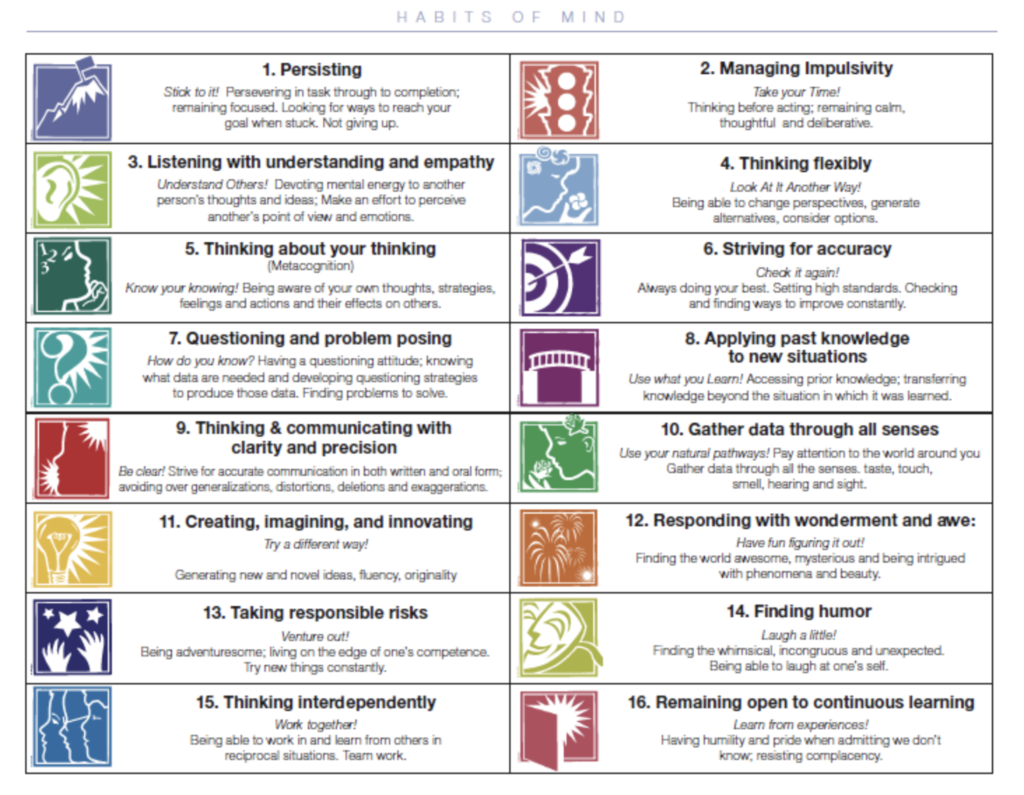
Implement Habits of Mind

Source: Screengrab from teachthought.com

Habits of Mind are dispositions that are mindfully employed by characteristically intelligent, successful people when they are confronted with problems. When we draw upon these mental resources, the results are more powerful, of higher quality, and of greater significance than if we fail to employ those habits. ‘Finding humour’ will help you to relax and take on stresses with some ease. Metacognition or ‘Thinking about your Thinking’ will aid you and your child to be more aware of the way you think and the reasons for why you arrive at a certain conclusion. Try some of them out yourself before introducing them to your child!

Give Your Child a Head Start

Photo by RDNE Stock project on Pexels

Ensure that both you and your child have a nice, relaxing break after PSLE. If you are nervous about some of the new subjects and demands that will arise in Secondary 1 however, find some fun, engaging holiday classes with preparatory lessons for the year ahead. This might assuage some anxiety, so long as it does not involve the stress of ‘mugging’ or a tutor who is obsessed with piling on holiday homework. Check out the classes offered at Curio: https://curio.sg/programmes/

Life in Secondary 1 will be daunting at first, and then the year will fly by and you will both settle into a new phase in your lives. Enjoy the journey!

Advice to My Younger Self

Sandy · April 8, 2023 · 2 Comments

"As I grew older I realised that the problem with the advice wasn't the advice itself, but the delivery. "

As a teenager, it was often frustrating to listen to ‘advice’, which came from a whole range of sources. It wasn’t always older people spouting it either, sometimes it came from my peers. There was a time when I felt that I had already figured most of life out. I read books, observed people, knew who I was and felt rooted in my identity. Why did everyone feel the need to dole out mostly unsolicited advice?

As I grew older I realised that the problem with the advice wasn’t the advice itself, but the delivery. There was an assumption that all teenagers are the same, at the same level of maturity and intellectual capability even, and that well-meant counsel of sorts could help guide us in the right direction. I would eventually realise that most of these pearls of wisdom would eventually prove useful, if not directly to me, at least to someone close to me whom I could help out:

Start Saving as Soon as You Can

Photo by Annie Spratt on Unsplash

Got an allowance? Open a savings account if you don’t have one already or ask for access to the one your parents set up for you, and start depositing your savings in there. It’s never too early to start saving. If your parents allow you to, get two accounts, one for saving and one for spending, so that you can always keep track of where your money is going. Saving money is not an automatic skill that you obtain once you reach adulthood, it is something that you can start practicing even in adolescence.

Read Widely

Photo by Christin Hume on Unsplash

In order to do well for your ‘O’ or ‘A’ levels? Well that’s just part of it. When you start reading widely from a young age, you expose your mind to a variety of topics and ideas which will not only turn you into a great conversationalist, but also into an intelligent, thinking, curious being who will connect with anyone, anywhere, making it easier for you to get a scholarship, ace an interview or even date the person of your dreams! Bill Gates, even with all his success, still reads 50 books a year to continue to improve himself and his various intiatives.

Stay Active

Photo by Saif71.com on Unsplash

Get into a rhythm doing your favourite sport or engaging in a fun calorie burning activity, then keep at it. Meeting your friends for badminton every month? Don’t give it up once you guys go to University. Going for a run during P.E. once a week? Keep that going once you graduate from school. It is easy to get swept up in the excitement and busyness that adulthood comes with in your 20s, and to neglect this most fundamental task that will keep you flexible and healthy well into your 30s and 40s. You will thank yourself when you turn 50.

Pursue Your Passion

Photo by russn_fckr on Unsplash

Don’t give up serenading people with your guitar, painting still life or playing basketball. You might never win an award or recognition for your talent, but that isn’t the point of your passion at all. Do it for your own enjoyment, spiritual growth and happiness. A lot of the time adulthood becomes about chasing the dollar or upgrading from house to house, car to car, promotion to promotion. Adults forget about the CCA or Saturday afternoon class that brought them so much joy and leave it behind locked up in their childhood. Don’t give up on your passion!

Don’t Smoke. Just Don’t

Well personally I never did, but the number of people around me who tried ‘just one puff’ or who continue to be ‘social smokers’ still astounds me. Sometime I think the only reason they might have picked it up is out of mere curiosity, about the one thing that was consistently denied to them in adolescence. Well it’s bad for you, it’s bad for your lungs, and it’s bad for your wallet. All that money you started saving as a kid will fly out the window with the smoke, and really, it’s Just. Not. Worth. It. Don’t do it. Don’t smoke.

These are just a few pieces of advice that I would have given to my younger self. At the end of the day, it’s also important to remember that you will make mistakes and have regrets, no matter what you’ve done to prevent them or how good the advice you’ve taken has been, so hang in there. More importantly, focus on being happy.

Helen Keller: Beyond Silence and Darkness

Sandy · April 8, 2023 · Leave a Comment

"Life is either a great adventure or nothing."

- Helen Keller

Helen Adams Keller was an advocate for persons with disabilities, a lecturer, activist and author. She accomplished all of these feats, completely blind and deaf. Born in 1880 in Alabama, USA, she lived in a time when persons with disabilities had very few resources to turn to, and when they were mostly ignored. Read on to find out how Helen Keller beat all the odds to live a fulfilling life.

Around the tender age of nineteen months, Helen Keller lost both sight and hearing after a terrible illness. Until the age of 7 years old, she moved around almost animal-like, angry with everyone and everything, bumping into things or eating her meals like a dog. Nobody in her family could get her to behave or understand what was going on around her, and indeed, were at a loss. A governess, Anne Sullivan appeared on the scene at this time, and the story of how she managed to teach, tame and transfer knowledge to Helen Keller became fodder for a play, ‘The Miracle Worker’ which has since been adapted into Oscar winning movies as well.

Anne Sullivan brought a doll as a present on her first day at the Kellers. Her first task involved teaching the sightless Helen the word ‘doll’ by spelling it into her hand. Helen was of course incredibly frustrated, there was no way of communicating to her that each object or person had a unique word to describe them. When Anne tried to teach Helen the word ‘mug’, Helen actually broke the mug in annoyance, as she had no idea what was going on. When interviewed later on, she would explain that she was just following along, making gestures with her hands as taught, but with no clue as to why she was being forced to make such odd signs.

Helen’s breakthrough came when Anne was running cool water through her hands, and then it appeared to click. The word being spelt into her hand was ‘water’! In her own words: “I stood still, my whole attention fixed upon the motions of her fingers. Suddenly I felt a misty consciousness as of something forgotten — a thrill of returning thought; and somehow the mystery of language was revealed to me. I knew then that w-a-t-e-r meant the wonderful cool something that was flowing over my hand. The living word awakened my soul, gave it light, hope, set it free!”

Anne Sullivan would become Helen’s life-long companion, while Helen would go on to become the first deaf-blind person to obtain a Bachelor of Arts degree. She even learnt to speak, and ‘hear’ using the Tadoma method, to read using Braille and to communicate with fingerspelling. She travelled to 25 countries, giving motivational speeches wherever she went about conditions for the deaf. Helen penned and published 12 books, advocated for women’s votes, pacifism, ending racism and more.

People often find the most inspiring aspect of Helen Keller’s life to be the fact that she accomplished so much despite being blind and deaf. I find that her achievements are impressive enough by themselves, even if she had not had any disability to speak of. May we all be inspired to live our best lives, no matter the circumstances.

7 Ways for Students to Increase Their Focus

Sandy · April 7, 2023 · Leave a Comment

"We often struggle to pay attention, but when presented with a task that we perceive to be difficult, we are more prone to giving up before truly attempting it."

Everyone struggles with their attention span at some point. External factors such as exhaustion from a packed schedule, lack of exercise or a disagreement with a loved one can be the cause of a loss of focus. Conversely, even oversleeping and too much Netflix or screen time can contribute to a wandering mind.

1. Have ‘Focus Breaks’

Photo by Pixabay on Pexels

You can use a timer or an app on your phone that reminds you to take breaks, or even have someone in your house pop by at a preset time with a drink (or cookies). 15 to 20 minutes is an ideal length of time for a break, but make sure you walk away from the screen or your study area and take a real break. What you do during your break is entirely up to you, but I would recommend having a stretch, looking out at some greenery, getting a hot drink or even lying down and closing your eyes. Some apps that might help: TomatoTimer, Time Out and Eyecare 20 20 20.

2. Adjust Your Study Time Frame

Photo by Enikő Tóth on Pexels

We are all unique individuals with our own ideal timings built for focus. You can try the famous Pomodoro Technique, which encourages people to work with the time they have rather than work against it. In the Pomodoro Technique, you will choose a task and allocate the total time you need for it. Set your timer to 25 minutes, work furiously and then take a 5 minute break. That’s it, you will have completed ‘1 Pomodoro’. After completing 4 sets of Pomodoros, you can give yourself a 20 to 30 minute break. Adjust this method as you see fit for yourself, and you will start to see improvements in your focus!

3. Include Exercise in Your Day

Photo by Pavel Danilyuk on Pexels

A lack of movement does generally contribute to lethargy, especially if you are on HBL. Even an activity as simple as stretching first thing in the morning will get your blood flowing and freshen up your mind for tasks in the day. If you are not a morning person, try some night cycling or an evening walk (with permission of course) and you will find your sleep greatly improved and your mind ready and set to concentrate the next morning.

4. Play Memory Games

Photo by Jonathan Kemper on Unsplash

That’s right! You are actually encouraged to play games in this instance. Memory games have been proven to build focus and to force you to concentrate. Some simple games only take 5 minutes to play and the increased attention you are forced to give in order to jog your memory will help you when you need to memorise dates or formulas. There are plenty of apps available but if you want to try a simple web-based site, you can go to: Memozor.

5. Reflect and Alternate Tasks

Reflect on a timetable after you have gone through the day or week. Were you more distracted on a Monday after the weekend and would prefer to focus on revising Math that day? Were you energized after a workout on a Thursday and felt like concentrating on History and Chemistry? Does writing out an English essay on a Friday feel like a drag? Alternate and move your timetable around as you see fit. There is no need to stick to or force yourself to a set schedule if it is not working out for you. Try writing down how you feel after each day e.g. ‘Today I took 2 hours to try just one sum, and I felt drained as I couldn’t get the answer’ or ‘Doing Biology revision on a Wednesday afternoon is great as it is just after Biology lessons in the morning’.

6. Remove Distractions

Photo by Howard Bouchevereau on Unsplash

People on a diet often remove all snacks and unhealthy foods from their fridges and cupboards, so that they aren’t tempted to eat them. Similarly, your study area should be distraction free. Place your phone outside your room if it is a source of distraction (and make sure you don’t have any apps on your laptop with friends messaging). Remove any clutter such as a gaming laptop or anything else that is a usual source of distraction.

7. Break Down Your Task

A lack of focus often stems from a task being perceived as too difficult or impossible at the beginning. Try breaking the task down into small steps and bite sized chunks, and then concentrate on finishing only that little chunk for the day. Make a checklist of the little chunks and then tick them off when you’re done. You will find a deep sense of satisfaction from being able to tick off the little bits and when the entire task is finally done, you can give yourself a clap on the back for being both organised and for a job well done!

School Breaks: 5 Ways for Students to Thrive

Sandy · April 7, 2023 · Leave a Comment

"When you think about it, vacation is a great time to get those tasks completed and set yourself ahead of the game once the break is over."

The holiday season is a time for relaxation and enjoyment, but it can also be a great opportunity for students to get ahead and prepare for the upcoming school year. Here are some ways that students can spend their holidays productively:

1. Catch Up on Classwork and Homework

Photo by Annushka Ahuja on Pexels

The holiday break provides a great opportunity for students to catch up on any assignments that they may have fallen behind on during the semester. This will help them start the new year on a strong footing and avoid the stress of trying to catch up once classes resume.

2. Set Goals for the Upcoming Semester

Photo by Ann H on Pexels

The holidays can also be a good time for students to reflect on their progress and set goals for the upcoming semester. This could include setting specific academic goals, such as improving grades in a particular subject, as well as personal goals, such as getting more involved in extracurricular activities or making new friends.

3. Get a Head Start on Next Semester’s Classes

Photo by Pavel Danilyuk on Pexels

Students can use the holiday break to preview the material that will be covered in their classes next semester. This could involve reviewing old notes and textbooks, or even doing some extra reading on topics that will be covered in the upcoming classes.

4. Take Care of Practical Matters

Photo by Towfiqu barbhuiya on Unsplash

The holidays can also be a good time for students to take care of practical matters, such as organising their schedules, buying textbooks, and making travel arrangements for the new semester. Getting these things out of the way early can help students start the new year off on the right foot.

5. Relax and Recharge

Photo by Aaron Burden on Unsplash

Finally, it’s important for students to take some time to relax and recharge during the holiday break. This could involve spending time with family and friends, engaging in hobbies and interests, or simply taking some time to unwind and de-stress.

Overall, the holiday break provides a great opportunity for students to catch up, set goals, and prepare for the upcoming semester. By using this time productively, students can start the new year off on the right foot and set themselves up for success.

IP, IB or ‘O’ Levels. Which is the Best Path?

Sandy · April 7, 2023 · 56 Comments

"Which path will work out best in the long run, IP, IB or 'O' Levels?"

Today, Singapore is known for its world-class education system. During the 1950s and 60s however, Singapore banked on a ‘survival-driven’ education system in order to generate a skilled workforce for the nation’s industrialisation push. We have come a long way since then, and there are now multiple pathways to a promising future.

The Cambridge ‘O’ Level/SEC Programme

Statistics from MOE, Singapore

The ‘O’ Levels have been offered in Singapore since 1971. It is considered a traditional path with rigorous academic demand.

Indeed, the majority of Singaporeans have gone through this particular exam and gone on to obtain acceptance into higher education institutions with ease.

The Cambridge ‘O’ Levels are widely recognised by both universities and employers internationally as evidence of excellent academic achievement.

Students are allowed to take up to a maximum of 9 subjects, and a minimum of 6.

From 2027, students will sit for the Singapore-Cambridge Secondary Education Certificate (SEC) examinations. There will be no change to the existing syllabus and examination format, beyond the regular updates that occur for each subject. The SEC exams will still be examined and awarded by Cambridge, as well as MOE and the Singapore Examinations and Assessment Board. The difference between the current format and SEC is that students will be taking subjects based on their strengths in each subject, and not based on a stream as is the case today.

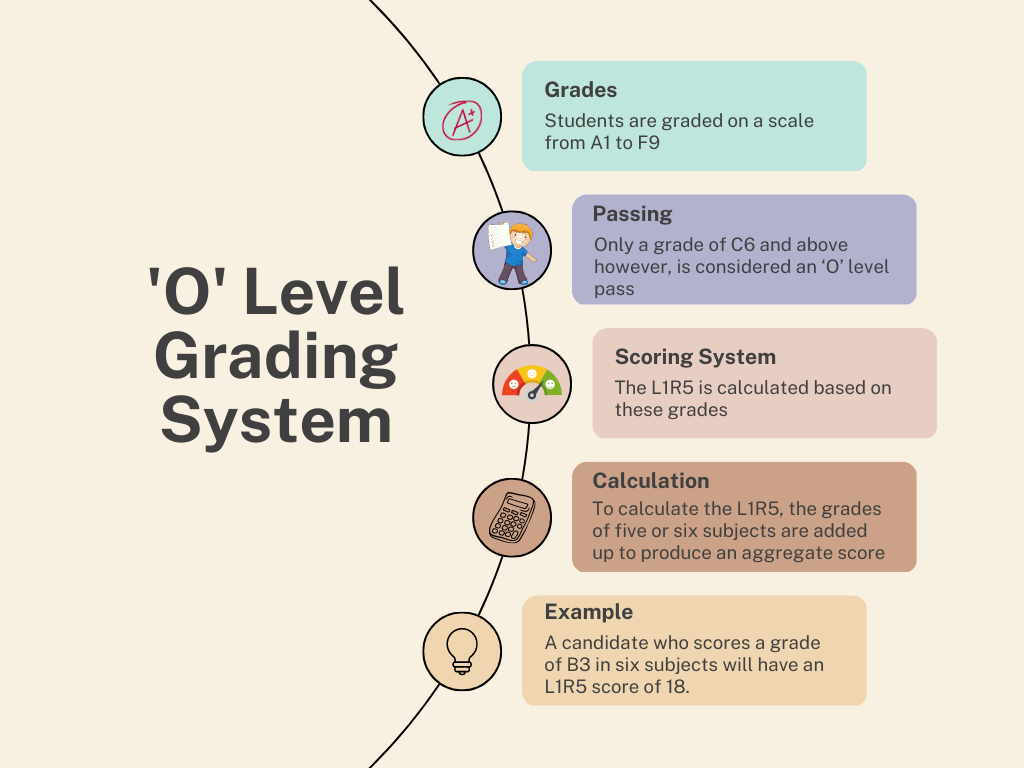
Grading is carried out as follows.

‘O’ Level Grading System

What Type of Student Would Enjoy the ‘O’ Level/SEC Programme?

The ‘O’ levels are considered the ‘traditional’ or ‘safe’ route by many, and in terms of opening up opportunities for higher education, it certainly is.

Many consider the programme to be content heavy with a focus on grades and academia, but schools and educators today have a variety of tools and resources in order to bring out the best in every student.

Students will have to take ownership of their education, learn how to take notes, condense and summarise their own learning.

Students who enjoy the ‘O’ level programme are driven by their interests, are determined to succeed and are willing to take risks, fail and learn from their mistakes.

The Integrated Programme (IP)

The Integrated Programme (IP) was introduced in 2004 in only 8 schools. It caters for high-ability students in Singapore at the secondary school level.  Instead of taking the GCE Ordinary Level (O-level) exam in Sec 4 or Sec 5, they will take the GCE Advanced Level (A-level) exam or the International Baccalaureate (IB) after six years of secondary education.

The IP is offered in the following 17 schools at the time of writing:

Nanyang Girls’ High SchoolCatholic High SchoolSingapore Chinese Girls’ School
National Junior CollegeCedar Girls’ Secondary SchoolTemasek Junior College
Raffles Girls’ School (Secondary)CHIJ St Nicholas Girls’ School Victoria School
Raffles Institution (Secondary)Dunman High SchoolHwa Chong Institution
River Valley High School
Schools offering the IP in Singapore

What type of student would enjoy the IP programme?

Academically, the IP is targeted at the top 10% of scorers in each PSLE cohort. The programme provides students with space to learn beyond textbooks and explore their interests in depth. Not having to spend 4 years in preparation for the ‘O’ levels allows for the time needed for students to delve deep in both academic and non-academic areas.

Schools offering the IP have the freedom to implement curriculum that imparts critical and analytical thinking skills, character building and leadership development.

Students who do well in the IP tend to be disciplined, motivated learners who are capable of keeping track of their own goals and progress. They truly enjoy school, learning and new challenges.

The International Baccalaureate (IB) Diploma Programme

The International Baccalaureate (IB) was founded in 1968. It offers a rigorous educational programme which is internationally lauded and renowned for its propensity to cultivate global citizens.

Creativity and the imagination are at the heart of the curriculum and students explore global issues with compassion as well as intellectual curiosity. Students don’t just learn, they also learn how to learn and are encouraged to excel both in their personal and academic lives.

Data from The Straits Times

6 subject groups form the IBDP: studies in language and literature; language acquisition; individuals and societies; the arts; mathematics; and the sciences. Students choose courses from these six groups, although choosing a subject from ‘The Arts’ is not always compulsory, depending on the school. Other subjects include Theory of Knowledge and Extended Essay.

The IBDP is offered at the secondary level in the following 5 schools (local) at the time of writing:

Anglo Chinese School (ACS) IndependentSJI International
Hwa Chong International SchoolSchool of the Arts (SOTA)
Anglo Chinese School (ACS) International
Local schools offering the IB in Singapore

A total of 28 schools (both local and international) currently offer the IBDP in Singapore.

What type of student would enjoy the IB programme?

Any student would benefit from the breadth and unique approaches to teaching which are available in the IBDP programme.

Perhaps one way to consider if you would thrive in the IB programme is to compare exam conditions. ‘O’ and ‘A’ level exams can be content heavy and grade focused, whilst IB students are graded on other assignments as well prior to the final exam.

About 70 to 80% of the final grade is determined by the final IB exams, giving some breathing space for students to work more gradually on achieving a desired grade.

The IB programme is thus suitable for students who are adept at time management, enjoy learning independently and conducting research.

Looking for Help with Some Subjects?

Photo by Annushka Ahuja on Pexels

Curio offers English Language, English Literature and General Paper group tuition in online classes. We cover the ‘O’ level, ‘A’ level and the new Singapore-Cambridge Secondary Education Certificate (SEC) which is to be offered in 2027. We also teach students in the Integrated Programme (IP) be it English, Literature or Language Arts. 

Beyond online group sessions, Curio also offers a unique Marking and Feedback programme for individual, independent learners. Students receive personalised worksheets on a weekly basis. Upon completion, Curio teachers will mark and provide personalised feedback. Curio teachers are also available via whatsapp and email for questions on anything related to the subject. Many of our students thrive from not having to block out time to attend weekly lessons, but still have the benefit of a Curio coach’s nurturing and experience.

To find out more, call or get in touch with us on whatsapp at 8892 2948. We are also available on email: [email protected].

How to Handle DSA Interviews

Sandy · April 6, 2023 · Leave a Comment

"The Direct School Admission scheme for secondary schools in Singapore allows students to apply to specific schools before taking the PSLE."

Has your DSA Interview been scheduled? Or are you still figuring out whether DSA is something your child should consider? Read on to understand more about the DSA process and for interview tips!

The Direct School Admission scheme for secondary schools in Singapore allows students to apply to specific schools before taking the PSLE.

Students apply based on their talent in sports, CCAs and specific academic areas. These areas include:

  • Sports and games
  • Visual, literary and performing arts
  • Debate and public speaking
  • Science, mathematics and engineering
  • Languages and humanities
  • Uniformed groups
  • Leadership (for example, prefects)

Preparing for the DSA Application Process:

1. Research

Photo by Katerina Holmes on Pexels

Research and read up about the school that you and your child are interested in. Focus also on the talent that your child plans to use to apply and most importantly, discuss everything with your child. If they are not truly interested or feeling forced/stressed out about this choice, it will show in the interview. Some parents also over-prepare and this can be unhealthy if it stresses your child out unnecessarily. Memorised answers and parrot-like responses don’t do well at interviews, while real interest and knowledge about a topic will always be evident.

2. Prepare for a Variety of Questions

Photo by Annushka Ahuja on Pexels

Typical questions would include: 1. Why should the school pick you? 2. Describe some of your interests and passions. 3. What are some personal qualities that make you unique? 4. Why did you pick this school? 5. What do you hope to do with your talent in the future?

However, also prepare your child for more introspective questions like: 1. If you were playing opposite your best friend and they asked you to lose on purpose, what would you do? 2. If you made a huge mistake while performing on stage how would you handle it? 3. If you had to pick one scientist/mathematician/famous person to have dinner with, who would you pick? 4. If you are the captain of your team and you are losing the game, what strategy would you use to try and win?

3. Get Students to Discuss Topics with Other Adults

Photo by Pavel Danilyuk on Pexels

At the end of the day, the interviews are a 2 way conversation and not a speech. If your child can speak naturally with other adults in their lives – uncles, aunts, tutors, friends – get them to have conversations with them about their personality and interests to develop confidence, so that they get used to speaking about themselves candidly and sincerely.

At the end of the day, schools are looking for students who have and can display genuine interest in the talent that they are using for the application, as well as personable students who are genuinely interested in joining the school.

The ‘O’ Levels: How to Achieve Your Goals

Sandy · April 6, 2023 · 1 Comment

"Goal setting may appear to be a simple process. However, in order to be productive and effective, a goal must be specific and clear."

Achieving your goals of doing well for your O level examinations may not be as daunting as you think. There are steps you can take and help that you can depend on. If you develop good habits and achieve consistency, there are hardly any limits to what you can achieve with your life!

Goal Setting

Photo by Markus Winkler on Unsplash

Take some time to sit down and really think through the goals you plan to achieve. It is often useful to start with the end in mind, e.g. planning on studying marine biology in a university overseas or getting into a JC of your choice. These are end goals that will help you to see the bigger picture, and keep you motivated. You can then set out individual goals for each of your subjects. Finally, work on the plan to attain each of these goals. It can involve reading one book a month to improve on your English or working on one question type for a particular topic every day for Math. Break down the steps to attain your bigger goals into very small, attainable goals.

Managing Expectations

Photo by AbsolutVision on Unsplash

Figure out which subjects you need more help for, and which ones you can handle by yourself. If you have been consistently failing or obtaining a C5/C6 in a subject, it is unrealistic to set a goal of getting an A1 by the next exam. Work your way up to a better grade slowly but surely. Remember, consistency is key.

Don’t compare yourself to others; focus on your own progress and improvement, setting realistic expectations that align with your abilities and efforts.

Honing Study Habits

Photo by Vlada Karpovich on Pexels

Your study habits are the most important element of your exam preparation. Every student learns differently, so stick to what works for you. You might be a morning person or a night owl, someone who can only work with colour coded notes or with copious amounts of coffee. Try out any of the tips below:

  • Minimise or remove all distractions from your study space (this includes putting your phone on work/study mode or leaving it outside your room)
  • Take breaks – try out any interval that works for you e.g. 40 minutes study time with 10 minute breaks or 25 minutes study time with 5 minute breaks.
  • Study in a conducive space – ensure it is quiet, cool enough and distraction free.
  • Set a study goal for each session, and ensure that you meet it to the best of your ability. This will give you a sense of accomplishment.
  • Reward yourself! Rewards can be anything which give you a feeling of contentment and spur you on to keep studying!
  • Ask for help: Grinding away during study sessions without progress can be discouraging. Try out tuition sessions at https://curio.sg/programmes/
  • Study with a group of like-minded friends. You can keep each other motivated as well as help one another with more challenging topics.

Achieving your goals may seem like a daunting task, especially if there are subjects you are struggling with. Speak to your parents, teachers and tutors and get some tailor made advice. Start early and stick to a solid plan. You’ve got this.

Are Wars Still Being Fought in the World Today?

Sandy · April 5, 2023 · 19 Comments

"Historians believe that the reason for this war arose most likely due to conflict over resources, as these were the times in which agriculture was taking the place of hunting and gathering."

Are Wars Still Being Fought in the World Today? Sadly, the answer to that question is yes, they have been going on ever since the first recorded war between the forces of Sumer and Elam in Mesopotamia in 2700BC. Historians believe that the reason for this war arose most likely due to conflict over resources, as these were the times in which agriculture was taking the place of hunting and gathering. This brings us to an age old question. Why do wars start in the first place?

Common reasons for war:

  1. To effect change in a nation’s government 
  2. Disagreements over territory 
  3. Disagreements over resources 
  4. Religion 
  5. Race or Culture 
  6. Revenge 

There have been conflicts amongst humans ever since, well, humans existed! Throughout history, great leaders have either been lauded for being brave and skilled at the art of war or praised for being able to keep their nations peaceful and prosperous. Millions of -mostly men- have died due to war however, and not always to a noble cause. According to the Merriam-Webster dictionary, war is the “state of usually open and declared armed hostile conflict between states or nations.” 

Today, in order for a war to be termed a war, some factors have to be taken into consideration: 

  • Fatalities are from battle related deaths as well as deaths of civilians who are intentionally targeted.
  • It must consist of armed force between 2 or more organized armed groups, whether governmental or non-governmental.

War in Afghanistan 

Photo by janeb13 on Pixabay

After the September 11 attacks in 2001, the United States invaded Afghanistan. The Taliban government lost control. From there, they have actively revolted against the U.S.-backed government in Kabul, international forces, as well as Afghan national security forces.

To date, the Taliban carries out suicide attacks in major cities. For more than four years the war has been deadlocked. The Afghan National Defense and Security Forces (ANDSF) continue to fight but suffer heavy casualties. In  2018, 10,993 civilian casualties were recorded, with the UN documenting 3,804 deaths and 7,189 injuries. The total UN-documented civilian casualties since 2010 is now at more than 100,000.

War in Yemen

Photo Defence-Imagery on Pixabay

Yemen’s civil war began in 2014 when Houthi insurgents took control of Yemen’s capital, Sana’a. They demanded that fuel prices be lowered and that a new government come into power. They seized the presidential palace in January 2015, which led to the resignation of President Abd Rabbu Mansour Hadi and his government. From March 2015, Saudi Arabia and various other gulf states imposed economic isolation and air strikes against the Houthi insurgents, with the support of the U.S.

The civilian casualty toll has exceeded 15,000 killed or injured. At the time of writing, twenty-two million Yemenis remain in desperate need of urgent aid, while eight million people are at risk of famine. A cholera outbreak has affected over one million people. The conflict today continues to destroy the lives of Yemeni civilians, effectively rendering Yemen as the place with the world’s worst humanitarian crisis.

How to Find Your Motivation: The What and the How

Sandy · April 5, 2023 · Leave a Comment

"Everyone is used to hearing maxims like “Stay Motivated!” or “Persevere! You can do it!” but no one tells us HOW."

Whether you have had to live through trying to motivate yourself through the ups and downs of the school year in 2020 or whether you struggle with motivation anyway, this article is for you. Everyone is used to hearing maxims like “Stay Motivated!” or “Persevere! You can do it!” but no one tells us HOW. So, we stumble along, try this and that. Truth is, there is a method to motivation, and the key to getting there is understanding the WHAT. What is Motivation? 

The What

Photo by Tim Mossholder on Unsplash

Educational psychologists espouse two main types of motivation, namely intrinsic motivation and extrinsic motivation. Ever become so engrossed in learning or doing something that you forgot to eat and didn’t even notice several hours slip by? Intrinsic motivation shows up when we have such an intense, genuine interest in the topic or subject that learning itself becomes a pleasure, and an all absorbing activity. Extrinsic motivation is when we have an external reward at the outcome of our learning. Good grades or a reward from parents for doing well are classic examples of extrinsic motivation. Yet, while we may idealize intrinsic motivation, the reality of academic life often demands a balance between both types.

Intrinsic motivation is of course, highly desired by us all, and it has been linked clearly with higher levels of academic achievement and better mental health. It’s impossible for us however, to conjure up intrinsic motivation whenever we feel like it. Calculus can’t always be done in a burst of inspiration, and neither can that history essay on World War II. 

Some people use a mixture of intrinsic and extrinsic motivation to push themselves. Enjoying the study of Shakespeare will be so much better with an A1 to show for it. Using a mixture of the two types of motivation is probably the best way for most students to push themselves and move forward.

The How: Intrinsic Motivation

Photo by Bonnie Kittle on Unsplash
  1. Find a place where you study best, be it a cafe, your kitchen table or the school library, and stick to the few places where you feel both comfortable and undistracted.
  2. Decide an order in which you will tackle your homework or study plan, whether it’s starting with the hardest bits first or the other way around, but have a plan.
  3. Adults, nag less and praise more. praise creates intrinsic motivation when it’s heartfelt and celebrates effort (e.g. “you worked really hard,” vs. “you’re so clever”) and communicates encouragement, not pressure (e.g. “you’re doing really well, keep it up” vs. “you’re doing really well,  just like I asked you to”)

The How: Extrinsic Motivation

Photo by Mindspace Studio on Unsplash
  1. They can be really really small rewards, but very useful. 45 minutes of studying followed by say, a bubble tea or 10 minutes of TikTok or a 15 minute power nap. Even ticking off a to-do list can provide a sense of accomplishment. Make sure it’s at least somewhat healthy or enjoyable without destroying your rhythm and focus, then get right back to studying. 
  2. Study in intervals and figure out the best combination for you. It can be 25 minutes of study followed by a 5 minute break or 75 minutes study followed by a 15 minute break. You do you. 
  3. Adults, talk to kids about their extrinsic motivations and then give them a little boost along the way, whether it’s hugs or Hawaiian pizza. 

There are incredibly creative ways to keep your motivation going, and they do indeed carry on into adulthood and work life. Try different ways until you figure out what works best for you. Importantly, don’t kick yourself when you’re down. Everyone has bad days when they feel like they can’t get anything done. Move on to the next day, and try, try, try again.

How Should I Choose My Subject Combination?

Sandy · April 5, 2023 · Leave a Comment

"Success and Happiness are choices, not destinations, and the subject combination you pick will not ultimately decide your fate."

We should play a game here. Two Lies One Truth, figure out which statement is true. 

Statement 1: The subject combination I pick will determine the course of the rest of my life. 

Statement 2: Following my interests will be my best bet.

Statement 3: The ‘triple science’ combination is the safest, and I can’t go wrong with it.

I will not be surprised to hear that most of you can’t figure out the truth because you have been told over and over again, that there is a set way of doing things, a ‘safe’ way, a way to ‘not make a mistake’. 

Newsflash: Statement 1 and 3 are false, and anyone who tells you, a 14 year old, that it’s possible to not ‘go wrong’ in life, is the biggest liar of all. Let’s get one fact out of the way, and the gentle truth is, you are going to make mistakes. Big ones and small ones. Some of you will make more mistakes than others, and some of you (like me) will trace a bit of the confusion in your life back to the point where you picked your subject combination at the end of Secondary Two. What is important to understand, is that life can get both weird and wonderful, promising and perplexing all at once, and that learning how to deal with it all is the real secret to success, and certainly not determined by the ‘perfect’ subject combination. 

Photo by Katerina Holmes on Pexels

Let’s take a look at Statement 1 for instance. “The subject combination I pick will determine the course of the rest of my life.” It is possible that not taking all the sciences might lead to you not obtaining a compulsory course, a requirement or prerequisite for Medicine, Dentistry, Pharmaceutical or Forensic Science and so on. The first question to ask yourself here then, is whether your heart already knows where it’s going. Not your mom’s or dad’s or grandma’s heart, but yours. Have you been dreaming about a career in medicine since you were in diapers? Are you genuinely interested in branches of medicine? Will the ability to heal others give you a sense of fulfillment? Do your grades also reflect this interest? Grades aren’t everything but let’s face it, if you’ve spent many nights losing hair and struggling to bond with the elements, you don’t really see yourself getting to know them even better over the next two years do you. The fact of the matter is, if you already know beyond the shadow of a doubt where you’re headed, one bad grade or nay saying teacher will not stop you, you will find a way to meet your destiny come hell or high water. 

Let’s take a look at the vast majority of students however. You don’t know what you want, and you have no idea who or what you’re going to be when you grow up. Heck you barely know who you are right now. You should not then allow this decision to plague your life. Go with the subjects that you find more interesting, or at the very least, that you find easier to score in. Don’t refer to just your final grade, but your entire journey with the subject so far. Did you really enjoy that Shakespeare group presentation you had to do way back in Term 1? Did the transfer of sound energy through vibrations cause a reverberation in your mind? Are quadratic equations actually – secretly – kind of… fun?

Remember that life is a continuous journey of growth and exploration. Know that whatever decision you make right now is not the end of the world. You are going to go on to graduate secondary school, further your education in whichever field you see fit, go out into the working world and then see that there are even more possibilities out there for you, and that ultimately, you determine your own path.

Steve Jobs told the world to “have the courage to follow your heart and intuition. They somehow already know what you truly want to become.” I will leave that here for you. 

How to Cope with Exam Anxiety and Perform at Your Best

Sandy · April 5, 2023 · Leave a Comment

"As a student, you can take several steps yourself to prevent a build-up of stress. Stress is like an invisible load that gets heavier if you ignore it or choose not to deal with it."

Read the statements below. Does one or more of them apply to you? 

  1. “I often worry that it will be difficult for me to take a test.”
  2. “I worry I will get poor grades at school.”
  3. “I feel very anxious even if I am well prepared for a test.”
  4. “I get very tense when I study for a test.” 
  5. “I get nervous when I do not know how to solve a task at school!”

These were the questions posed to 5,825 Singaporean students in a study conducted by the Organisation for Economic Cooperation and Development (OECD) in 2017. The response was disturbing: 76% of students reported feeling extremely anxious for a test, even if they were well prepared for it, and the results overall revealed high levels of stress and distress when it comes to academic performance. 

This isn’t news to any of us. Students in Singapore have been exhibiting and complaining about stress for many years. The Ministry of Education takes a serious view of it and has taken and continues to take measures to combat this issue on many levels, especially before it takes a turn for the worse. To understand why this issue persists despite these efforts, it’s important to consider the deeper cultural roots of our education system.

One reason for this level of stress probably just goes back to our culture. Our predominantly Asian population retains an intense focus on the value and importance of education. Images of our grand and great grandparents spanking our ancestors and forcing them to study with candlelight over many hours comes to mind. Culturally, being only the very best at one’s educational pursuits has often been viewed as the only path to success.

Photo by Brodie on Burst

Some steps you can take are:

  1. Pay attention to your sleep. Having regular hours of sleep is more important to your performance than studying late into the night, and being exhausted throughout the school day.
  2. Drink plenty of water. Water is brain juice, it helps to clear your mind and refresh your body.
  3. Eat your fruits and vegetables! Bubble tea and fried snacks are yummy, but don’t forget to eat your fruits and vegetables regularly, as they are crucial for your well-being and overall health.
  4. Communicate with a loved one about your problems, be it a family member or a good friend. Talking it out will help ease your mind and heart.
  5. Set realistic goals. Don’t stuff your timetable with so much work that your mind becomes too exhausted to continue.
  6. Have a plan! Planning out your revision will help you focus on your weaker subjects without neglecting your stronger ones.
  7. Believe in yourself! Write out goals and notes of encouragement to yourself and stick it up on your laptop or even your bedroom walls! (You can get friends and family to write them too, the more the merrier!)
  • « Go to Previous Page
  • Page 1
  • Page 2
  • Page 3
  • Page 4
  • Go to Next Page »

CURIO

Copyright © 2026 Curio Singapore · Log in

  • Home
  • Journal
  • Contact
  • Terms and Conditions
  • Free Resources